
According to a new study, classifying acetabular structures may require an updated system. The study, “There Is No Column: A New Classification for Acetabular Fractures,” was published in the January 17, 2018 edition of The Journal of Bone and Joint Surgery.
Rethinking Acetabular Fractures: A New Classification System
2 min read Premium comments
#hipfractureSecondary#hip#acetabulum
Amir Herman, M.D., Ph.D., with the Department of Orthopaedic Surgery at Sheba Medical Center in Tel HaShomer, Israel and co-author on the study, told OTW, “As an orthopaedic surgeon treating fractures I consider acetabular fractures as the most complex fractures. The anatomy, fracture mechanics and pathophysiology has always fascinated me.”
“The widely used Judet and Letournel’s acetabulum classification has been created 50 years ago. It assumes that the acetabulum is held by two columns—anterior and posterior.”
“Today we know more about these fractures than was known 50 years ago. We see different fracture patterns and have newer methods of surgical approaches and fixation techniques. That has led us to think that a new way of thinking of acetabulum fractures is in order.”
“As any research that involves classification, our work was retrospective in nature. We reviewed the fractures treated in our institute trying by 3D CT to identify common patterns.”
The authors wrote, “The study included 229 patients with acetabular fractures treated between 2007 and 2016. The mean patient age (and standard deviation) was 46.7 ± 21. 75 years, and 172 patients (75.1%) were surgically treated.”
“According to the novel classification system, the posterior displacement vector group included 60 patients, the superomedial displacement vector group included 130 patients, the combined displacement vector group included 36 patients, and 3 patients were unclassified by the new system. Forty-six patients (20.1%) could not be classified by the Judet and Letournel classification.”
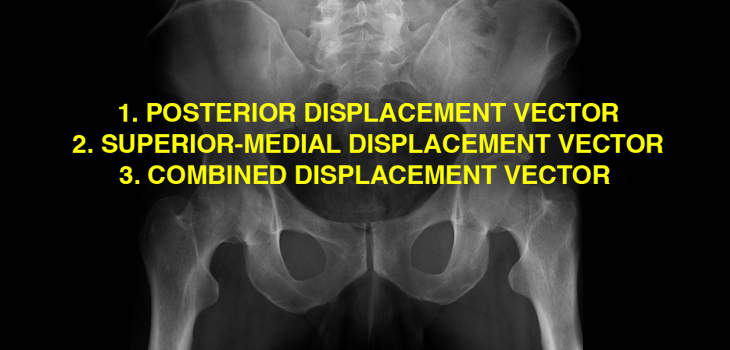
Dr. Herman told OTW, “The most important result is a new way of thinking about acetabulum fractures. We think that there should be three major groups of fractures according to fracture displacement vector:
- Posterior displacement vector;
- Superior-Medial displacement vector;
- Combined displacement vector.
Each of these groups is further divided to two or three subcategories according to the anatomical structures that were involved in the fracture pattern.”
“We should first consider the fracture displacement vector and then the specific anatomic structures involved. This is not only a terminology change. According to the displacement vector we should determine the surgical approach. According to the anatomic structures involved we should determine the fixation devices used.”
“We should reconsider the basic concepts of acetabulum columns. This will direct us to a new classification according to displacement vector. The proposed classification is not only a terminology change it is a new way of thinking about these fractures.”
Author
React:
Discussion
This is a fascinating development. In my practice we've seen similar outcomes with the revised protocol. The key differentiator seems to be patient selection criteria. Has anyone else noticed the correlation with BMI thresholds?
Great point. I'd push back slightly on the conclusion, the sample size in the cited study is too small to draw population-level inferences. That said, the directional signal is compelling and worth a larger RCT.
We implemented a similar approach last year. Early results are promising but we're still gathering 12-month follow-up data. Happy to share our protocol if anyone is interested.
Join the conversation
Orthopedic professionals are discussing this. Sign in and upgrade to read every comment and add your voice.