
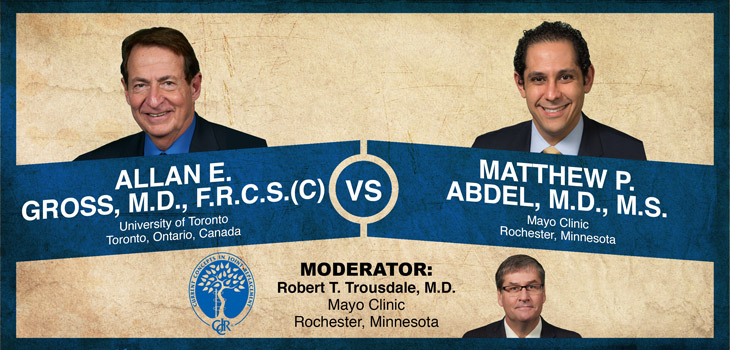
This week’s Orthopaedic Crossfire® debate was part of the 33rd Annual Current Concepts in Joint Replacement® (CCJR®), Winter meeting, which took place in Orlando. This week’s topic is “Avoiding Instability: The Transtrochanteric Approach.” For is Allan E. Gross, M.D., F.R.C.S.(C), University of Toronto, Toronto, Ontario, Canada. Opposing is Matthew P. Abdel, M.D., Mayo Clinic, Rochester, Minnesota. Moderating is Robert T. Trousdale, M.D., Mayo Clinic, Rochester, Minnesota.
Gross v. Abdel: Avoiding Instability: The Transtrochanteric Approach
10 min read Premium comments
#hipreplacement#hipsurgeryGreat Debates#hip
Dr. Gross: I have to tell you right at the beginning that the speaker that was originally given this topic routinely takes off the greater trochanter for primary hip replacements and he does them in the classical Charnley fashion cementing both sides of the joint. I’m sure he does an excellent job.
I do not do this approach for primary hip replacements, but I do it for difficult primaries and complex revisions. So, my mandate is just to convince you when you have to take it off, take it off. Don’t be afraid and I will show you a technique which really decreases instability.
The posterior approach is probably the most commonly used approach in North America and is used in about 60-65% of the cases. So I’m going to compare that to the modified trochanteric slide and the modified extended trochanteric osteotomy which is a type of trochanteric osteotomy which is done exactly the same as we do the modified trochanteric slide.
The advantages of the modified trochanteric slide, which is what we call it—modified trochanteric slide—that’s very important—is that you get extensive exposure of the acetabulum and the femur. There is a decreased dislocation risk, as you’ll see from our data. And it can be converted to a transverse osteotomy by releasing the vastus lateralis if you have to. But that should be very, very rare that you have to do that because that increases the incidence of trochanteric migration.
The disadvantage of taking off the trochanter is that you can get a non-union particularly with the trochanteric slide, but much less so with the extended trochanteric osteotomy because you have a bigger bone apposition surface.
If plating of the ischium is required, if you use our technique, you have to take off the external rotators and the posterior capsule to expose the posterior column. While using our technique decreases the dislocation risk, it doesn’t give that exposure that you would need to plate the posterior column.
The longer the trochanteric fragment, the less the incidence of trochanteric non-union. If you don’t have a greater trochanter because it’s like a third-time revision, then we do something like a fake trochanteric slide where we pretend there is a trochanteric fragment and we have one continuous sheath of conductive muscle where the greater trochanter was in the vastus lateralis.
The posterior approach has the advantage in that it offers extensile exposure including the ischium. If more exposure is needed—and this is very important—you can easily convert it to a trochanteric osteotomy. The disadvantages are the risk of dislocation; exposure of the femoral canal is more limited than with the trochanteric slide; and traction of the superior gluteal nerve when extensive exposure of the ilium is required.
So the approach that we use and it’s very important to note…this is why we call it the modified slide… we leave the posterior capsule and the external rotators attached to the main body of the femur. You have the abductors; greater trochanter; vastus lateralis; one continuous sheath and that inhibits trochanteric migration. It requires just two cerclage wires for closure. We leave the external rotators and the posterior capsule intact, attached to the main body of the femur, vastus lateralis, abductors—it’s all one continuous sheath. And then the rest of your exposure is done anteriorly.
Out of 83 cases we’ve had only 4 non-unions. Remember I don’t do this for primary hip replacements. These are all difficult primaries and complex revisions. We’ve had 4 non-unions; 4 dislocations—that’s 4.8%, but in this particular population that’s very respectable; and only 6 patients developed a new abductor lurch.
What I’m trying to say is that if you need additional exposure, don’t be afraid to take off the greater trochanter. But if you do take it off, keep the vastus attached and leave the external rotators and capsule attached to the main body of the femur.
Dr. Abdel: I think this will be an interesting discussion between two groups. I’m going to be opposing transtrochanteric osteotomy in the primary setting.
There are multiple approaches available to the surgeon when considering primary total hip arthroplasty. These include posteriorly based ones such as a posterolateral; anteriorly based incisions such as anterolateral; direct lateral; direct anterior; and bony based approaches, primarily that of the trans-trochanteric osteotomy.
When I consider the approach for my primary total hip arthroplasty, I think of three goals. First: have adequate exposure of both the femur and the acetabulum; it must be an extensile approach, if I need it. Second: I want to maximize stability with my approach. Third: I want it to be safely reproducible. That is, both you and I on a daily basis need to be able to do this approach safely.
Why do I oppose a transtrochanteric approach for primary total hip arthroplasty? Well, it’s quite simple. It breaks all three rules. It compromises future exposures. Trochanteric non-union is a real issue, reported everywhere from 5% to 30% and those that do have a non-union have up to a 20% instability rate. And it lacks safe reproducibility.
Let’s look at these in depth. What about the exposure? Is there a role for the transtrochanteric approach? Well, certainly one might argue for an ankylosed hip; those with severe acetabular protrusion; or massive heterotopic ossification may benefit with the transtrochanteric approach. However, I would argue that it makes future exposures difficult especially when we have excellent solutions including laterally based or anteriorly based extended trochanteric osteotomies that have nearly 99% union rates in complex revision settings. That’s data from our institution, including our moderator.
Unique and unacceptable complications come with the routine use of this approach in primary total hip arthroplasty.
Let’s move on to stability. Does this approach help? Well, let’s look at the status of the trochanter. If it does not unite, you have up to an 18% rate of instability. Even in those scenarios where it unites, the reported rate of stability with the use of this approach is 2.8%. I would argue that in 2016, that rate is probably higher, given our lack of expertise with routinely utilizing this approach. In addition, multiple studies have looked at contemporary dislocation rates with the posterolateral or several anteriorly based approaches and found them to be approximately 1%.
Finally, and maybe most importantly, when completing a primary total hip arthroplasty, it must be safely reproducible. The transtrochanteric approach is performed by very few. It’s technically demanding. And there is a host of variability with regards to techniques for the osteotomy and techniques for fixation. In my mind, that makes it not reproducible, not reliable, and not durable, and as such, not a good approach for primary total hip arthroplasty.
In the short list there are multiple different ways to complete the osteotomy, including Chevron trochanteric osteotomy; trochanteric slide; and partial trochanteric osteotomies. In addition, there’s significant variation of fixation including wires, cables and claw-type plates; and several of these have issues for patients requiring removal.
There are uses for this approach in the revision setting. In that setting, the reported rate of bony non-union is 16%, lurch in 1-in-3 and dislocation approximately 5%. But as Dr. Gross pointed out, these are traditionally in patients with very difficult situations such as revision procedures or complex primaries.
In summary, I would argue the transtrochanteric approach to primary hip arthroplasty has a very limited role. There are certainly increased rates of pain and limp that are unacceptable to most contemporary patients. In addition, it’s prohibitively high trochanteric non-union and instability rates are certainly no better than other contemporary approaches.
Moderator Trousdale: So let’s try to get a little bit of consensus over the next five minutes. Allan and Matt, I think you’ll agree, because I just heard you say, that a classic trochanteric osteotomy is rarely needed in a primary total hip.
Dr. Gross: Yes, I agree.
Dr. Abdel: I agree with that.
Moderator Trousdale: And would everyone agree that in some revisions, some type of osteotomy can be beneficial, but not necessarily all revisions?
Dr. Gross: In the panel earlier this morning a lot of the cases that were presented by various speakers showed that they had done a trochanteric osteotomy, only for the complex acetabular revision.
Moderator Trousdale: Okay, so let’s talk about the primary first then we’ll talk about the revision because they’re really two different animals. Matt, is there any complex primary…you mentioned a few, I think fusion takedown, where you wouldn’t do an osteotomy on that, but you could, HO and a big deformity, are those the major reasons where you may entertain a classic osteotomy for primary total hip?
Dr. Abdel: I think in addition to those, the other thing you could think about is those patients who have a primary antalgic process; they need the trochanter and abductor mechanism moved out of the way to get at the lesion. So in my practice that’s the primary use of that approach in a primary setting. Complex tumor resection.
Moderator Trousdale: Allan, in a primary setting, when would you do a classical osteotomy?
Dr. Gross: There are some CDH cases where we like to take out the greater trochanter and then we get better exposure, especially if we have to do a graft, and then we can advance it because some of them have a very high riding greater trochanter. We like to cut the neck short to neutralize version, instead of doing a sub-trochanteric osteotomy. In those cases, if we leave the trochanter attached, it ends up to be very high riding. We like to take it off and advance it and it also improves stability.
Moderator Trousdale: Let’s talk about the revision setting. Matt, when would you do some type of extended osteotomy in the revision population?
Dr. Abdel: With difficult acetabular exposures I’ll use an osteotomy. You can do an anteriorly based or laterally based one. That gives you great exposure. If there’s any issue with femoral anatomy or distal cement plugs or fixation issues, I’ll do an osteotomy. The goal here, of course, is to protect the abductor complex connected to the proximal aspect of the trochanter, so I prefer to go to an osteotomy and have a nice bony bridge with soft tissue attachment, rather than fracturing it off doing something else.
Moderator Trousdale: Good point. Allan, you taught me a few years ago that idea of leaving the posterior capsule which was a big game changer in my practice for instability issues, so I do a similar thing. You do a posterior based approach and leave those rotators intact—that’s great for post-operative instability, so thank you for that. One problem I have with the laterally or anteriorly based osteotomy is occasionally you’ll do that to increase apposition, but what do you do when you do that and the trochanter breaks off the segment of cortical lateral bone, which can happen in the revision setting? How do you handle that? Now you’ve got two pieces of laterally based trochanter instead of the one long piece?
Dr. Gross: There’s two things you can do. If worse comes to worst, you can get a short cortical strut and use it as an onlay graft so that you get continuity between the greater trochanter and that fractured piece. The other thing you can do is go to a claw if you have to. But you rarely, rarely will go to the claw.
Moderator Trousdale: Those are pretty biologically unfriendly. Matt, you mentioned you sometimes use an anterior based osteotomy versus a posterior based ETO. Tell everybody how you make the decision to do a sort of anterior Wagner-type osteotomy where the anterior half of the femur is taken off versus a laterally based osteotomy from posterior to anterior, where the whole lateral femur is taken off.
Dr. Abdel: My workhorse would, obviously, be mostly a laterally based osteotomy, but I think there is a role for the anterior based osteotomy, particularly in periprosthetic fractures. I think that kind of classic transfemoral or bony Hardinge is beneficial in those scenarios. Or if you have certain deformities you have to look at the scenarios where the trochanter is in the way, if the deformity is going to mostly be removed by taking out the anterior half of the femur, I’ll do that. But my workhorse is a laterally based osteotomy in most cases.
Moderator Trousdale: Allan, when do you do a posterior-based or laterally based fragment versus an anterior-based?
Dr. Gross: The only time we would do the anterior based is if we’ve done a transgluteal approach, we get into trouble and we need more exposure. That’s one indication. And the other is the periprosthetic fracture because sometimes that periprosthetic fracture actually communicates…it’s almost a Wagner approach having been done by the fracture.
Moderator Trousdale: Thank you gentlemen. That was a great discussion on a tough problem.
Please visit www.CCJR.com to register for the 2018 CCJR Spring Meeting, – May 20 – 23 in Las Vegas.
Senior Editor: Jay D. Mabrey, M.D., whose 35 year career in orthopedics included residency at Duke University Medical Center, service in the United States Army Medical Corps, Fellowship at the Hospital for Special Surgery and a long, distinguished career at Baylor University Medical Center where, in addition to his overall leadership at that institution, developed the Joint Wellness Program that helped patients get up after surgery more quickly, developed the first virtual reality surgical simulator for knee arthroscopy and chaired the FDA Orthopaedic Device Panel, is Orthopedics This Week’s newest contributing writer and editor.
Author
React:
Discussion
This is a fascinating development. In my practice we've seen similar outcomes with the revised protocol. The key differentiator seems to be patient selection criteria. Has anyone else noticed the correlation with BMI thresholds?
Great point. I'd push back slightly on the conclusion, the sample size in the cited study is too small to draw population-level inferences. That said, the directional signal is compelling and worth a larger RCT.
We implemented a similar approach last year. Early results are promising but we're still gathering 12-month follow-up data. Happy to share our protocol if anyone is interested.
Join the conversation
Orthopedic professionals are discussing this. Sign in and upgrade to read every comment and add your voice.