
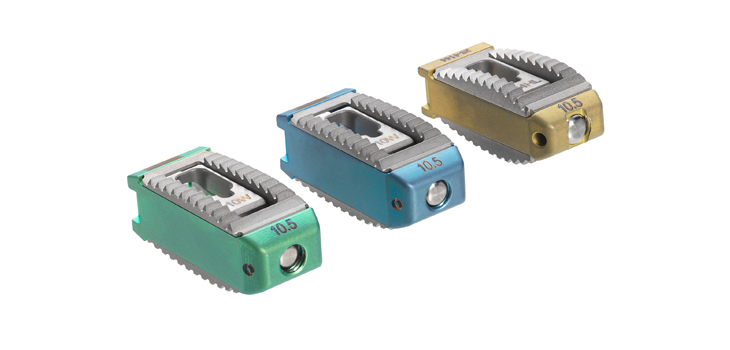
The FDA has given 510(k) clearance for an expandable spacer system made by Orthofix International N.V.
Continuous Expansion Spacer System Cleared by FDA
2 min read Premium comments
#orthofix#backpainSecondary#degenerativediscdisease#fdaclearance#expandablespacer
The clearance of the FORZA XP Expandable Spacer System was announced by the company on February 6, 2018. At the same time, the company announced the limited market launch of the system for the U.S.
The company said the FORZA was unlike other incremental expandable interbody devices, in that their systems allows for a “continuous controlled expansion and a custom fit to the disc space. Once the desired expansion is achieved the device features automatic locking which further adds to its ease of use.”
After insertion into the disc space to fit a patient’s anatomy, the spacer, like other systems, is designed to restore normal disc height in patients suffering from degenerative disc disease.
The FORZA is made primarily of titanium alloy and used for PLIF (Posterior Lumbar Interbody Fusion) and TLIF (Transforaminal Lumbar Interbody Fusion) procedures.
Orthofix Spine Fixation President Ray Fujikawa said the systems, “offers an industry-leading 6.5mm starting height and also enables surgeons to place bone graft material inside the device after implantation. The ability to pack our new expandable device with bone graft post expansion is extremely important to ensure proper contact of the material with the vertebral endplates.”
Indications
According to an FDA summary, the system is indicated for “spinal fusion procedures in skeletally mature patients with degenerative disc disease (DDD) at one or two contiguous levels in the lumbar spine (L2-S1). DDD is defined as back pain of discogenic origin with degeneration of the disc confirmed by patient history and radiographic studies. DDD patients may also have up to Grade 1 spondylolisthesis at the involved levels. These patients may have had a previous non-fusion surgery at the involved level(s).”
“In addition, the system is intended for use with autograft and/or allograft comprised of cancellous and/or corticocancellous bone graft and supplemental fixation” (i.e., Firebird Spinal Fixation System).
Patients must have undergone a regimen of at least six months of non-operative treatment prior to being treated with FORZA XP Expandable Spacer System.
The clearance request was submitted on September 7, 2017 and clearance was granted on January 19, 2018.
Predicate Devices
Predicate devices included the Atlas Spine Expandable Interbody System, the FORZA Spacer System, the Centurion POCT (Posterior Occipital Cervico-Thoracic) System, the SKYHAWK Interbody Fusion System and the SKYHAWK Lateral Plate System.
Author
React:
Discussion
This is a fascinating development. In my practice we've seen similar outcomes with the revised protocol. The key differentiator seems to be patient selection criteria. Has anyone else noticed the correlation with BMI thresholds?
Great point. I'd push back slightly on the conclusion, the sample size in the cited study is too small to draw population-level inferences. That said, the directional signal is compelling and worth a larger RCT.
We implemented a similar approach last year. Early results are promising but we're still gathering 12-month follow-up data. Happy to share our protocol if anyone is interested.
Join the conversation
Orthopedic professionals are discussing this. Sign in and upgrade to read every comment and add your voice.