
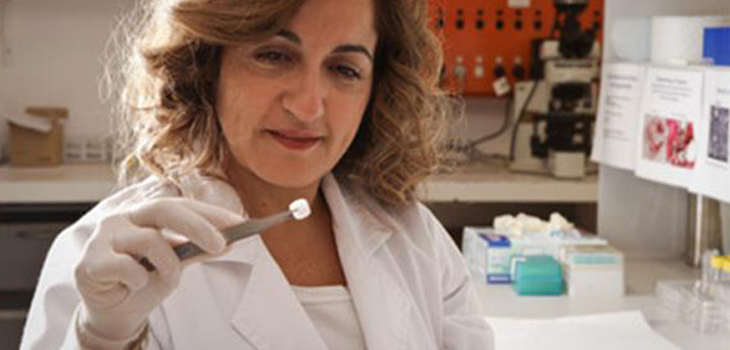
Researchers at the University of Sidney, Australia, have developed a 3D implant which, they believe, could mend broken bones. Led by Professor Hala Zreiqat, a team of researchers at the Biomaterials and Tissue Engineering Research Unit have developed a 3D printed ceramic implant that mends broken limbs by gradually turning them into natural bone.
3D Printed Biomaterial Speeds Fracture Healing
2 min read Premium comments
Secondary#fractures#3dprinting
The implants were found to be effective in 2013 when they tested them on a group of rabbits with fractures. The implant appeared to shorten the time of recovery for the animals.
Following the rabbit study, they set up a test involving eight sheep with fractured legs. For the first month after the sheep received the implant, they were fitted with casts on their legs for support.
All of the sheep could walk immediately after the operation took place. Within three months, two of the sheep’s fractures were completely healed. All the sheep’s fractures, with the exception of one, were completely healed after a year.
Using this technology, the teams of researchers at the University have developed a 3D implant which, they believe, could mend many kinds of broken bones.
The implant is porous and becomes a ‘scaffold’ that the bone can grow through. At present some fractures on humans are repaired using metal screws, rods and plates which permanently remain in the body. The utilization of this implant avoids any permanent artificial changes to the patient’s body. The scaffold is readily dissolved leaving behind a newly formed natural bone in its place.
The bones have the same strength as they did prior to their fracture. The implant is composed of similar materials to that of natural bone already present in the body. None of the animals’ immune systems recognized the implant as foreign, so none of them received the immunosuppressant drugs that are often used in surgery to inhibit the immune system when it is expected that the patient’s body will reject the transplanted material.
Immunosuppressant drugs may not be required if this this becomes a standard treatment for fractures. This could be beneficial to patients as they are more vulnerable to infection when taking immunosuppressants, and often will have a long-term dependence on immunosuppressant drugs to prevent immune responses to the foreign material in their bodies.
3D printing allows for flexibility of design and means that the implant can be constructed in a way that matches the patient’s damage. With 3D printing technologies, it is possible to 3D print a cast that perfectly fits the patient, providing better support. A 3D scanner can generate a model of the patient’s limb.
This can be combined with the information gathered from an X-ray scan of the fracture to design a cast tailored to the patient and his break. The cast could be printed and used in conjunction with the 3D printed implant to further improve the healing of fractures.
The researchers are convinced that 3D printing could be utilized for the repair of many other parts of body. They maintain it is theoretically possible that at some point doctors will be able to 3D print most structural parts of the human body and will be able to replace body parts that fail to repair naturally.
Author
React:
Discussion
This is a fascinating development. In my practice we've seen similar outcomes with the revised protocol. The key differentiator seems to be patient selection criteria. Has anyone else noticed the correlation with BMI thresholds?
Great point. I'd push back slightly on the conclusion, the sample size in the cited study is too small to draw population-level inferences. That said, the directional signal is compelling and worth a larger RCT.
We implemented a similar approach last year. Early results are promising but we're still gathering 12-month follow-up data. Happy to share our protocol if anyone is interested.
Join the conversation
Orthopedic professionals are discussing this. Sign in and upgrade to read every comment and add your voice.