
The traditional school of thought in sports medicine when it comes to ankle injuries in volleyball has always been that they occur in a plantarflexed position, but a new study suggests otherwise.
Volleyball: Blocking the Cause of Most Ankle Injuries
1 min read Premium comments
Secondary
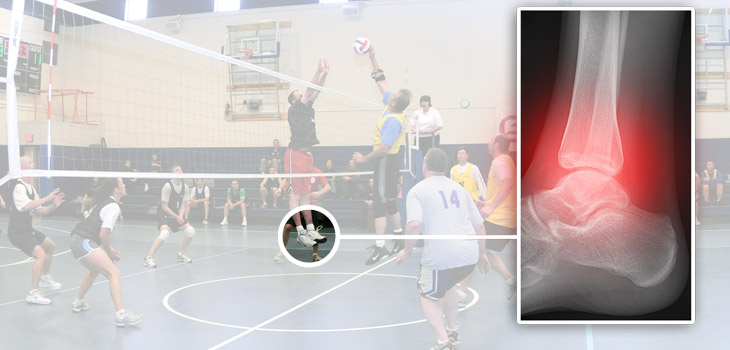
In “Landing-related ankle injuries do not occur in plantarflexion as once thought: a systematic video analysis of ankle injuries in world-class volleyball,” published in the January 2018 issue of the British Journal of Sports Medicine, researchers suggest that it is not landing in a plantarflexed position, but blocking that causes the most ankle injuries in volleyball.
The researchers analyzed videos of 24 injuries from major International Volleyball Federation tournaments (14 men and 10 women) through the federation’s injury surveillance system. Specific situations and mechanisms leading to the injuries were determined from the videos.
According to the data, most of the ankle injuries occurred during blocking (n = 15) and attacking (n = 6). When the blocker was injured it was either because they landed on an opponent (n = 11) or a teammate (n = 4). Attacking injuries most often occurred when a back-row players landed on a front-row teammate (n=4 of 6).
The researchers wrote, “When landing on an opponent under the net, the attacker landed into the opponent’s court in 11 of 12 situations, but without violating the center line rule. Injuries mostly resulted from rapid inversion without any substantial plantarflexion.”
They concluded, “The majority of injuries occur while blocking, often landing on an opponent. The attacker is overwhelmingly to blame for injuries at the net secondary to crossing the center line.”
Author
React:
Discussion
This is a fascinating development. In my practice we've seen similar outcomes with the revised protocol. The key differentiator seems to be patient selection criteria. Has anyone else noticed the correlation with BMI thresholds?
Great point. I'd push back slightly on the conclusion, the sample size in the cited study is too small to draw population-level inferences. That said, the directional signal is compelling and worth a larger RCT.
We implemented a similar approach last year. Early results are promising but we're still gathering 12-month follow-up data. Happy to share our protocol if anyone is interested.
Join the conversation
Orthopedic professionals are discussing this. Sign in and upgrade to read every comment and add your voice.