
Researchers from the UK have determined that trabecular metal (TM) implants could be an alternative to open reduction and internal fixation with bone grafting when it comes to ulnar nonunions. Their case study, “Novel use of a trabecular metal spacer in the treatment of a long-standing ulnar fracture non-union,” appears in the December 7, 2017 edition of BMJ Case Reports.
Trabecular Metal Implants for Ulnar Nonunions?
1 min read Premium comments
Secondary
Oluwatobi O. Onafowokan, with the Orthopaedics Department at Royal Cornwall Hospitals NHS Trust in Truro, UK and co-author on the study, told OTW, “Trabecular metal implants have already been successfully applied in various forms in spine, hip, knee and foot and ankle surgery. There are no reports of their use in managing upper limb pathology.”
“In this case, we were interested in investigating whether the technology offered an intervention for managing a longstanding ulnar fracture nonunion with resultant significant bony defect, which was less expensive than traditional methods (i.e., open reduction and internal fixation with bone grafting), but also potentially offered similar outcomes for patients.”
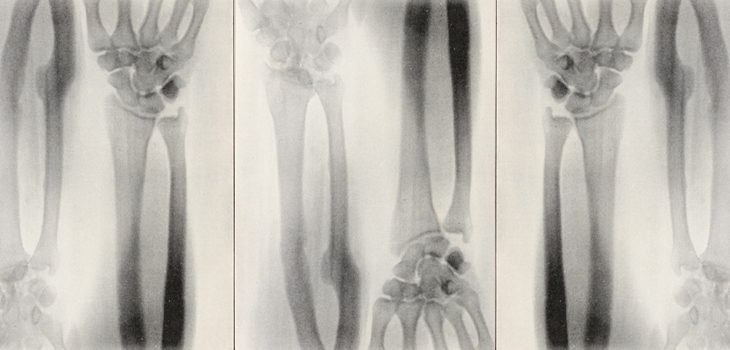
The authors wrote, “We present our experience in using a TM implant for treating a patient with a long-standing ulnar fracture non-union. Excision of devitalised bone resulted in a 17mm defect which the TM implant was used to infill. The defect was then bridged with a locking plate.”
Oluwatobi O. Onafowokan commented to OTW, “The patient achieved an excellent result, returning to full arm function less than two years after surgery. Radiographs also confirmed complete integration, with bone growth across the implant between both opposing ends of the ulnar.”
“Bone graft is generally an expensive, finite resource. Orthopaedic surgeons may wish to consider alternative interventions such as trabecular metal implants, particularly in cases with considerable bony defect, which would otherwise require a large amount of bone graft.”
Author
React:
Discussion
This is a fascinating development. In my practice we've seen similar outcomes with the revised protocol. The key differentiator seems to be patient selection criteria. Has anyone else noticed the correlation with BMI thresholds?
Great point. I'd push back slightly on the conclusion, the sample size in the cited study is too small to draw population-level inferences. That said, the directional signal is compelling and worth a larger RCT.
We implemented a similar approach last year. Early results are promising but we're still gathering 12-month follow-up data. Happy to share our protocol if anyone is interested.
Join the conversation
Orthopedic professionals are discussing this. Sign in and upgrade to read every comment and add your voice.