
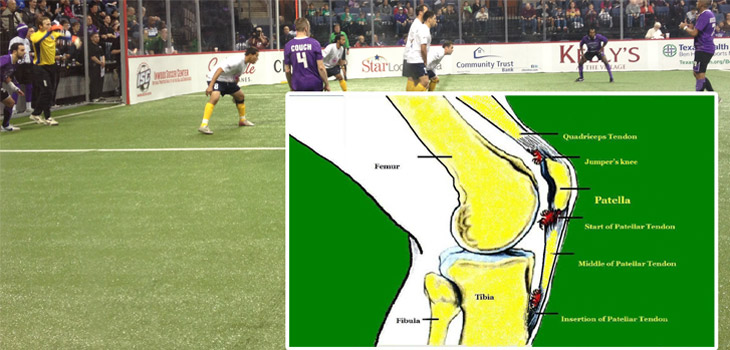
According to a press release, San Diego Socker’s Brian Farber is back on the soccer field two and a half years thanks to the regenerative medicine treatment he received at the San Diego Orthobiologics Medical Group after suffering a potentially career-ending knee injury and torn patellar ligament.
San Diego Socker’s Farber Makes Comeback Thanks to SDOMG
1 min read Premium comments
Secondary
Farber for a long time searched for the right treatment that would allow him to return to competitive soccer, but it took two years of failed treatments for him to find what he was hoping for.
Not considered a good candidate for surgery, Farber was initially prescribed physical therapy as treatment and told that he would have to learn how to manage the pain. The pain was too debilitating however to go back to competitive play forcing him to consider retiring until he was introduced to Christopher Rogers, M.D., founder of the San Diego Orthobiologics Medical Group (SDOMG), who offered to treat him with Lipogems, an FDA compliant medical device that uses a patient’s adipose tissue to heal the injured tissue. The adipose tissue is harvested through liposuction and then injected into the site of the injury using high resolution ultrasound imaging. Rogers was one of the first doctors in San Diego to offer this treatment.
Farber agreed and after treatment, the rehabilitation process began. Farber slowed down his activity for 10 days to help the healing process then underwent physical therapy and progressive strengthening and treatment with BEMER technology as part of his follow-up care. Six months later he was strong enough to return to play with his team.
“It feels great to run without pain,” Farber said in the release. He was recently voted Comeback Player of the Year and selected to the Indoor National Team.
Author
React:
Discussion
This is a fascinating development. In my practice we've seen similar outcomes with the revised protocol. The key differentiator seems to be patient selection criteria. Has anyone else noticed the correlation with BMI thresholds?
Great point. I'd push back slightly on the conclusion, the sample size in the cited study is too small to draw population-level inferences. That said, the directional signal is compelling and worth a larger RCT.
We implemented a similar approach last year. Early results are promising but we're still gathering 12-month follow-up data. Happy to share our protocol if anyone is interested.
Join the conversation
Orthopedic professionals are discussing this. Sign in and upgrade to read every comment and add your voice.