
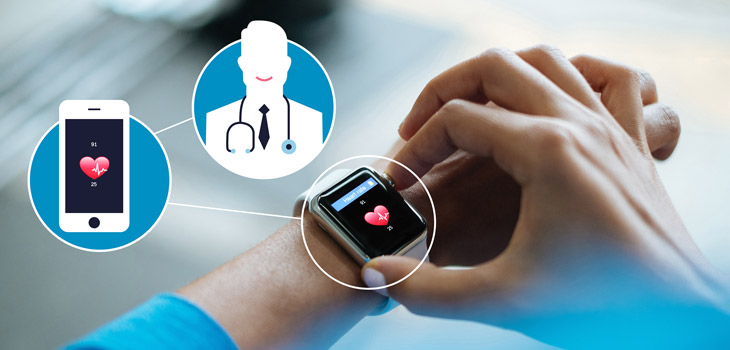
We might not like it when technology seems to spy on us. In some instances, however, it might be handy. Consider the case of wearable devices linked to your phone that can help ensure a faster, smoother recovery from surgery.
Mid-Course Update on the Wearables Data Revolution
5 min read Premium comments
#pain#surgery
Stephen Lyman, Ph.D. is an associate scientist at HSS and has made the testing and development of wearables a focus. In his view, wearables are uniquely suited to improving large joint surgery outcomes: “There are more than one million people annually who undergo hip and knee replacement in this country. Ensuring that we have a complete picture of their surgical recovery is an enormous job—one that can be helped by the emerging technology of wearable sensors and data collection.”
Elaborating on the history of wearable technology, Dr. Lyman talked about his experience at HSS “We were initially interested in these devices as a way to monitor patient activity after treatment in order to see whether their activity level increased, decreased, or remained the same. We wanted to know the signal—the relationship between how the patient is feeling and the information we were getting.”
“While these measures were available via off the shelf devices, the data points may not tell the full story. For example, if a smartphone is sitting on the counter instead of in the patient’s pocket or purse, we can’t capture their additional steps. Additionally, data points like step count can be misleading as a measure of mobility.”
“So, for patients after knee replacement surgery, we might not see an increase in the number of steps they take in a day, but that doesn’t mean mobility hasn’t improved and that they’re walking around with less pain.”
Dr. Lyman undertook a study of postoperative data collection from 150 hip surgeries and 150 knee surgeries which were performed at 12 doctors’ offices.
“We started with step counts tracked by an app on a smartphone. After hip or knee replacement we assessed recovery over time as patients increasing their steps per day. Originally, we expected that their steps were going to exceed their preoperative activity levels.”
“We monitored patients’ steps for a month preoperatively to obtain a baseline; then, interestingly, we found that they didn’t walk more after surgery. Upon digging into the data, however, we found that one cohort doubled their step counts while the other returned to baseline. Those patients who were less active before surgery were the ones who returned to their ‘normal.’”
“My hypothesis is that patients in the group that returned to baseline were walking just a little preoperatively, and doing so in pain. I think the other group, however, included patients who were preoperatively more active, had been limited by their disability, and after surgery could return to their active lifestyles.”
“Ideally, we would have collected data on expectations so that we could differentiate more clearly what these patients hoped to achieve from their surgery.”
“Unfortunately, mobile phone tracking is limited in females because they may place the phone in their purses or on a counter, meaning that the steps are being under counted. And there is fact that some elderly patients are not comfortable interacting with smartphones.”
“We had one patient who, despite being enthusiastic, was not at all familiar with apps. He had the TMobile staff load the app necessary for the study…then when he was done, he returned to TMobile and had them remove it from his phone.”
“Our next step was to use a Fitbit to assess stress fractures of the lower extremity in athletes. If someone is too active then he or she is not going to recover well, so the activity needs to be limited. Our goal is to determine the safe threshold for daily steps without aggravating the injury or keeping it from healing. To date we have enrolled about 30 patients.”
“In addition, we plan to examine commercially available trackers that have been developed for medical purposes. Specifically, we are looking at technologies that are designed to manage postoperative rehab for knee replacement patients.”
Wearables and Physical Therapy
“Everyone is searching for ways to save money these days, and cutting out extraneous physical therapy (PT) sessions is one potential strategy. So, the idea is, ‘How much PT does a given patient really need?’ And, if we can help patients do PT in an independent fashion (without therapist present) that saves a substantial amount of money.”
“We have specific kits with an app and a wearable device where we walk patients through the rehab protocol for their given surgery. The kit measures range of motion in the knee. One early complication of knee replacement is stiffness and one way to prevent that is through adequate rehab.”
“Smartphone serves as the interface with wearable, meaning that the patient doesn’t have to locate the app…they just turn on the device. The idea is that patients wear these during PT (and hopefully will keep them on all day).”
“These devices have sensors that are much more robust than fitness trackers. They can pick up whether the patient is limping, how much knee flexion they have during the day, whether they are sitting or standing. The study is under IRB [Institutional Review Board] review at the moment and will move forward soon.”
What’s next?
“There is a lot of potential here,” says Dr. Lyman. “We are in the early stages as far as how to use these devices contribute to outcomes clinically.”
“Our research is currently aimed at seeing what information we can gather. It will likely be five years until we know what all of this means clinically. It’s too early to give this information to doctors because they won’t know what to do with it.”
“And there is always the issue that if the patient feels that the information was available, but was not used to manage their care, then there is a chance of litigation if something goes wrong. Later on we will take all of this to clinicians and say, ‘How would you use this information to monitor your patients remotely?’”
Dr. Lyman says that the ultimate prize as far as wearables is enhanced outcomes. “I would like to conduct a randomized clinical trial with a group of patients using a wearable and a control group and see which group has a better recovery. And, thinking way ahead into the future, why couldn’t we determine a way for a wearable to measure energy expenditure? That way we could have a tangible way to measure when a patient is experiencing pain.”
“Assessing patient outcomes accurately, and on a large scale, is essential to providing the best care we can. Unfortunately, the long-term patient outcome data in orthopedics available today has significant limitations. This is one reason there is such a wide disparity in quality and cost of care for musculoskeletal conditions. For instance, the rate of complications after hip and knee surgery can be more than three times higher for procedures performed at some hospitals than others. Wearables are an important step forward to evaluating the success of orthopedic procedures and improving care.”
Author
React:
Discussion
This is a fascinating development. In my practice we've seen similar outcomes with the revised protocol. The key differentiator seems to be patient selection criteria. Has anyone else noticed the correlation with BMI thresholds?
Great point. I'd push back slightly on the conclusion, the sample size in the cited study is too small to draw population-level inferences. That said, the directional signal is compelling and worth a larger RCT.
We implemented a similar approach last year. Early results are promising but we're still gathering 12-month follow-up data. Happy to share our protocol if anyone is interested.
Join the conversation
Orthopedic professionals are discussing this. Sign in and upgrade to read every comment and add your voice.