
Back in November, Medovex Corporation announced the submission of an Investigational Device Exemption (IDE) request to the FDA, for the DenerveX System, a non-addictive, non-opioid drug alternative, “designed for enduring relief of Facet Joint Syndrome related to chronic back pain.”
Medovex Pulls Back FDA IDE to Pre-Submission
2 min read Premium comments
Secondary
On December 29, 2017, after conversations with the FDA, the company announced it was voluntarily converting the IDE to a Pre-Submission with the FDA.
“Early dialogue with the FDA has been both encouraging and productive. The feedback gained from recent interactions convinced us that converting the IDE submission to a pre-submission beneficially allows us to engage in a more interactive and collaborative review of the planned clinical investigation,” said Jill Schweiger, Senior Vice President Regulatory and Clinical Affairs for Medovex.
She added, “The standard IDE review timeframe is 30 days, while our submission exceeded nearly 2,500 pages of technical data. We are confident that early collaboration with FDA regarding its planned clinical evaluation will help ensure that the study design will ultimately yield the results that will support the safety and effectiveness of the DenerveX System.”
Schweiger said she believes the company will ultimately have a successful submission and review by the FDA, followed by a U.S. clinical trial in the future.
The company said it is also “working as planned with several early adopting physicians on the collection of the initial clinical results in the UK and Germany for post procedural outcomes of patients treated with the DenerveX System. This data is expected to support a scientific abstract being planned for submission late in 2018. To maintain the best chance of abstract acceptance, the scientific abstract will include data collection from various sites, comprehensive analysis and will not be released to the public before presentation.”
Jarrett Gorlin, the company’s CEO said, “We are confident that the data will show a consistent trend with the data initially reported in the manual method by Dr. Haufe in his clinical paper.”
Dr. Scott M. W. Haufe, M.D. is Medovex’s co-founder and independent director. He is a board-certified physician in the fields of Anesthesiology, Pain Medicine, and Hospice /Palliative Medicine. Dr. Haufe serves as Chief of Anesthesiology and Pain Management with St. Lucie Anesthesia Associates in Florida.
RF Denervation Device
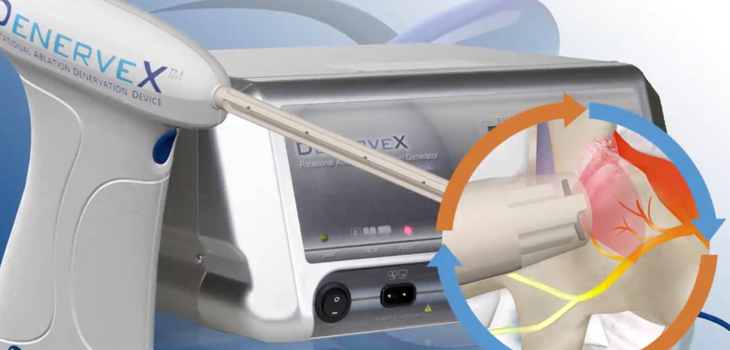
The company says the system “…is a rotational, monopolar, radiofrequency [RF] denervation device, powered by a dedicated DenerveX Pro-40 generator. It is designed to ablate the nerve and capsular tissue on the posterior surface of the facet joint. Denervation is achieved through Rotacapsulation, a combination of high heat and rotational tissue shaving.”
The procedure, according to the company, “…denervates and removes capsular tissue from the Facet Joint in one single procedure. Treatment results from the combined effect of a deburring or polishing action and RF ablation treatment on the joint. The slowly rotating burr removes the targeted facet joint synovial membrane and joint surface while the heat ablation destroys tissue and denudes any residual nervous and synovial membrane overlying the joint, removing the end point sensory tissue of the joint.”
Each device is provided in a procedure tray with “…a 1mm K-wire, Procedure Dilator, Portal Tube, Portal Driver and Tissue Stabilizer…accessories are designed for single-use and provided sterile.”
Author
React:
Discussion
This is a fascinating development. In my practice we've seen similar outcomes with the revised protocol. The key differentiator seems to be patient selection criteria. Has anyone else noticed the correlation with BMI thresholds?
Great point. I'd push back slightly on the conclusion, the sample size in the cited study is too small to draw population-level inferences. That said, the directional signal is compelling and worth a larger RCT.
We implemented a similar approach last year. Early results are promising but we're still gathering 12-month follow-up data. Happy to share our protocol if anyone is interested.
Join the conversation
Orthopedic professionals are discussing this. Sign in and upgrade to read every comment and add your voice.