
IlluminOss Medical, Inc. has received FDA De Novo clearance for its bone stabilization system.
IlluminOss Medical Gets First FDA Ortho De Novo Clearance
2 min read Premium comments
Secondary
This is a big deal. The company says this is the first time the FDA’s orthopedic branch has granted such a clearance since the Food and Drug Administration Safety and Innovation Act (FDASIA) was amended in 2012 to allow a sponsor to submit a De Novo classification request to the FDA without first being required to submit a 510(k).
IlluminOss Bone Stabilization System
The IlluminOss Bone Stabilization System is for treatment of impending and actual pathological fractures of the humerus, radius and ulna from metastatic bone disease.
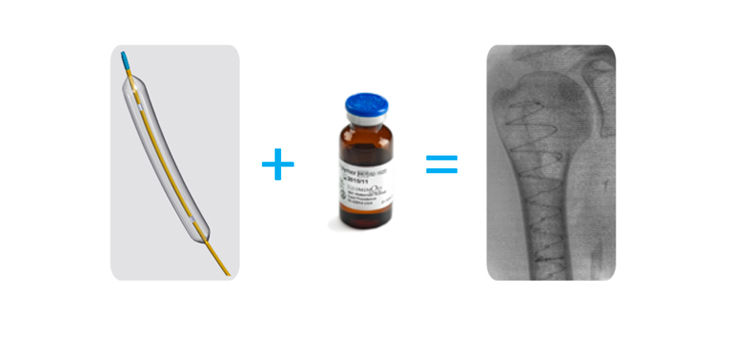
In a January 9, 2018 announcement, the company said the system incorporates the use of a thin-walled PET balloon that is infused with a liquid monomer and delivered in a minimally invasive fashion into the intramedullary canal of the bone through a small incision.
“Once the balloon is infused with monomer, it conforms to the shape of the patient’s specific bone. The surgeon then activates a light source which delivers visible light to the PET balloon, polymerizing the monomer. The cured, hardened implant provides longitudinal strength and rotational stability over the length of the implant, stabilizing the fracture,” states the company.
The system has been commercially available in international markets and been in clinical use since 2010. The company plans to start commercialization efforts in the U.S. in the second quarter of 2018.
Surgeons’ experiences with the product in the international markets, says the company, have reported “smaller incisions, shorter procedural times, faster return to patients’ daily living activities, with reduced hospital stays and lower complication rates for patients.”
Richard McGough, M.D., Department of Orthopaedic Surgery, University of Pittsburgh Medical Center, says the systems, “has significantly changed the way we are able to approach the treatment of certain impending and actual pathological fractures resulting from metastatic bone disease. We were able to offer patients a quick, reliable surgical option that minimized pain and hospitalization. We were also able to consolidate their treatments; in some cases, we moved from two-day admissions to outpatient surgery, and we were ultimately able to complete radiation much more quickly.”
John Healey, M.D. Chief of Orthopaedic Surgery, Memorial Sloan Kettering Cancer Center, says since the device doesn’t violate the rotator cuff and can be inserted with reduced operative time and blood loss, “it relieves pain and restores function more effectively than alternative treatments, in my experience.”
De Novo Process
Devices that are classified through the De Novo process may be marketed and used as predicates for future 510(k) submissions.
Since 2010, the FDA has begun releasing summary documents for devices classified through the De Novo process. The summaries are intended to present a summary of the scientific evidence that served as the basis for the decision to grant a De Novo request. The De Novo summary also serves as a resource regarding the types of information necessary to support substantial equivalence for device manufacturers that may wish to use the device as a predicate for future 510(k) submissions.
Author
React:
Discussion
This is a fascinating development. In my practice we've seen similar outcomes with the revised protocol. The key differentiator seems to be patient selection criteria. Has anyone else noticed the correlation with BMI thresholds?
Great point. I'd push back slightly on the conclusion, the sample size in the cited study is too small to draw population-level inferences. That said, the directional signal is compelling and worth a larger RCT.
We implemented a similar approach last year. Early results are promising but we're still gathering 12-month follow-up data. Happy to share our protocol if anyone is interested.
Join the conversation
Orthopedic professionals are discussing this. Sign in and upgrade to read every comment and add your voice.