
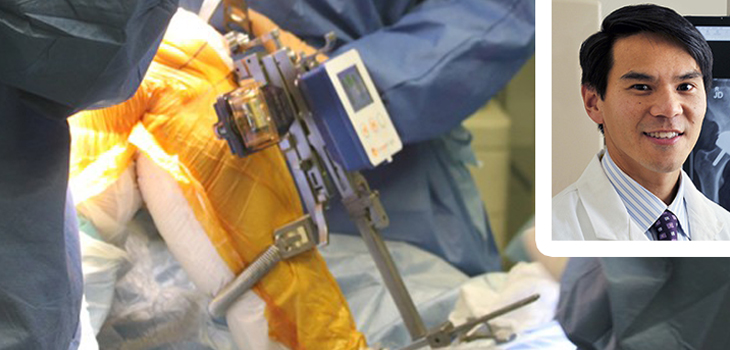
New unpublished research from Hospital for Special Surgery (HSS) in New York compared the HipAlign navigation system and traditional methods of acetabular cup placement, taking into account the time required for fluoroscopy as well. HipAlign is manufactured by OrthAlign, based in Aliso Viejo, California.
Handheld Navigation Augments Implant Placement, Reduces Radiation
1 min read Premium comments
Secondary
The authors wrote, “Data was prospectively collected for a group of consecutive DAA [direct anterior approach] THA [total hip arthroplasty] procedures using a handheld navigation system (n=50) by a single surgeon.”
“This was compared to data retrospectively collected for a group that underwent the same procedure without use of the navigation system (n=50). The time for use of the navigation system, including insertion of pins/registration, guiding cup position, and removal of pins, was recorded intraoperatively.”
“Postoperative anteroposterior and cross-table lateral radiographs were used to measure acetabular inclination and anteversion angles. Targeted angles for all cases were 40° ±5 for inclination and 20° ±5 for anteversion. Intraoperative fluoroscopy exposure times were obtained from post-anesthesia care unit radiographs.”
Asked how he selected this particular navigation system, co-author Edwin Su, M.D., a hip and knee surgeon at HSS, told OTW, “I’ve had experience with using their technology in total knee replacements, and found it to enhance my results. I’ve been helping them develop the application for use in the anterior total hip, to provide the same kind of intraoperative information that can help surgeons perform this type of surgery.”
“The most interesting results were that a significantly greater percentage of acetabular components were positioned in a target zone, as opposed to those THA performed conventionally. This means greater precision in implant placement, while at the same time reducing the risks of radiation to the surgeon, operative staff, and patient.”
“I believe that this technology can help surgeons who perform this type of operation with intraoperative information to achieve their surgical plan, while reducing the exposure to fluoroscopy.”
Author
React:
Discussion
This is a fascinating development. In my practice we've seen similar outcomes with the revised protocol. The key differentiator seems to be patient selection criteria. Has anyone else noticed the correlation with BMI thresholds?
Great point. I'd push back slightly on the conclusion, the sample size in the cited study is too small to draw population-level inferences. That said, the directional signal is compelling and worth a larger RCT.
We implemented a similar approach last year. Early results are promising but we're still gathering 12-month follow-up data. Happy to share our protocol if anyone is interested.
Join the conversation
Orthopedic professionals are discussing this. Sign in and upgrade to read every comment and add your voice.