
It’s a bird? It’s a plane? No…it’s flying blood samples—and they’re going further than ever.
New Record for Medical Drones: 161 Miles
5 min read Premium comments
#johnshopkinsschoolofmedicine#jeffstreet#medicaldrones#timothyamukele
Johns Hopkins researchers have announced a new distance record for medical drones, successfully delivering human blood samples across 161 miles of the Arizona desert.
From takeoff to touchdown the person in charge of this historic event was Timothy Amukele, M.D., Ph.D., assistant professor of pathology at the Johns Hopkins School of Medicine in Baltimore, Maryland. Dr. Amukele, who has worked with drones for three years, says his involvement began after a conversation with a visionary medical student by the name of Jeff Street. “Jeff wanted to use drones to deliver medications in India,” said Dr. Amukele to OTW. “I initially thought this was a terrible idea because it would be too expensive. I soon learned, however, that using a drone would be less expensive than delivering medications via motorcycle.”
One of the tricky things in using drones to transport medical samples, says Dr. Amukele, is the fragility of the samples. “I agreed to help design a stability study; the next thing I knew I was a drone engineer.”
“Once we started working on the medical drone transport project, it became clear that there were three challenges to address to make this idea a reality.”
“The first was the stability of the biological material, the sample itself; the second was engineering; and the last was regulation and public opinion.”
“We set out three years ago to work on the first issue of sample stability, thinking that the engineering and public relations [PR] aspects would be handled by others. But we were wrong. We have had to gain expertise in engineering as well as learn how to engage with the public. We have worked closely with—and learned from—PR professionals, and spend a significant part of our time engaging with the public and public officials.”
In three years of flights Tim Amukele and Jeff Street had succeeded in making the drones fly for a total of 40 minutes. “We wanted to take things further, says Dr. Amukele. “What would happen in cold and in temperate climates? What about if it flies longer and in hotter climates? We began getting requests to undertake drone deliveries in Africa and the Middle East…and people wanted the drones to travel 100 kilometers. We knew the drones could do it—the engineering was solid—but we didn’t know if the blood samples would remain stable that long. We had to custom-build a refrigeration unit that is powered by the onboard battery.”
Their fourth publication on medical drones was recently published. The article, “Drone Transport of Chemistry and Hematology Samples Over Long Distances,” appears in the September 5, 2017 edition of the American Journal of Clinical Pathology.
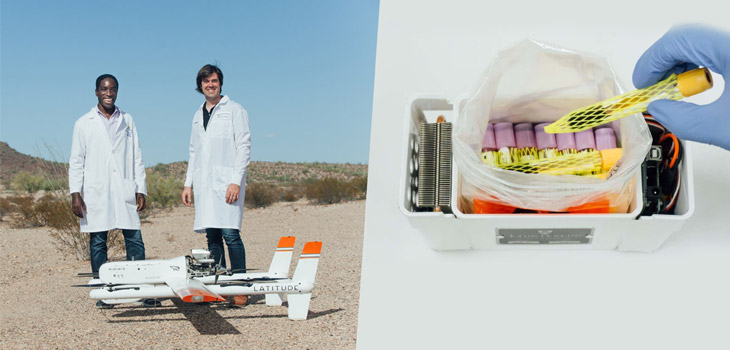
“All samples were packed and transported in accordance with International Air Transport Association guidelines,” says Dr. Amukele. “The drone we used was a Latitude Engineering HQ-40.”
The authors wrote, “A hybrid aircraft was selected over other aircraft types because it combines the ability to launch and land vertically (like a helicopter) with a range several times that of a helicopter or multirotor aircraft. The HQ-40 launches, with lift provided by four vertical propellers, and at 75 feet makes a transition to a traditional horizontal flight by engaging a forward thrust motor and a short time later stopping the vertical thrust propellers. Landing is performed by the inverse procedure.”
But what about the gas-powered engine on the drone? “We were concerned that the vibration may affect the samples, so we individually packed the blood samples in mesh sleeves and then sealed the primary containers in biohazard bags. The items were then placed inside the cooler and put inside a custom-built foam-lined carrier.”
For this study, the researchers collected 84 blood samples at the University of Arizona in Tucson and then drove them to an airfield. The area was cleared of any other traffic, and the certified drone pilot set things in motion for what would be a three-hour flight.
“When the drone landed,” says Dr. Amukele, “we drove the samples 62 miles to the Mayo Clinic in Scottsdale, Arizona. We performed 19 chemistry and hematology tests and found that samples that were flown and those that were not flown showed similar results for red blood cell, white blood cell and platelet counts and sodium levels. There were minor statistically significant but small differences found in glucose and potassium levels, which also showed variation in standard transport methods (e.g., automobile transport). These were because of chemical degradation from slightly warmer temperature in the samples that were not flown.”
And how does Dr. Amukele envision drones being used in the orthopedic world? “I see three ways that they could be practical in orthopedics,” he says. “First, the delivery of medical samples such as bone or blood that is destined for a laboratory. Small items such as surgical equipment could also be handled by a drone. There are drones that can lift a human being, but I don’t see drones replacing ambulances or trucks. I think they are an answer for small cargo of high value. The second use in orthopedics could be small surgical or pharmaceutical cargo. The third would be the delivery of blood to patients in remote areas.”
“There is already a company in East Africa—Zipline—that is using drones to deliver blood products to 21 transfusing facilites. If, for example, an obstetric patient starts to bleed unexpectedly, it is critical to get blood to the mother as fast as possible. We differ from them because they only do blood products; we see ourselves as becoming a full transportation service.”
But not quite yet, says Dr. Amukele. “We need to complete the validation experiments first, then we can establish a company.”
As for other plans, Dr. Amukele told OTW, “In early 2018 we are starting a new project to deliver medicines to clinics in northeastern Namibia. This is an area that typically has lots of flooding, so drones are especially helpful.”
“We receive requests all the time from individuals and companies here in the states to come install a drone network. Many of these institutions have locations scattered over areas where there is lots of traffic. Like many states their roads were built for a 1960s population…and now things need to move faster.”
And while there may be some turbulence on the road to progress, the drones are here to stay. Dr. Amukele told OTW, “Drones can operate where there are no roads, and overcome conditions that cars and trucks cannot handle. In the 21st century they will be increasingly indispensable for prompt patient diagnoses and care.”
“I decided to get on board and learn about drones. The fact is that people’s needs are broader than my imagination.”
To learn more about this work, visit medicaldrones.org.
Author
React:
Discussion
This is a fascinating development. In my practice we've seen similar outcomes with the revised protocol. The key differentiator seems to be patient selection criteria. Has anyone else noticed the correlation with BMI thresholds?
Great point. I'd push back slightly on the conclusion, the sample size in the cited study is too small to draw population-level inferences. That said, the directional signal is compelling and worth a larger RCT.
We implemented a similar approach last year. Early results are promising but we're still gathering 12-month follow-up data. Happy to share our protocol if anyone is interested.
Join the conversation
Orthopedic professionals are discussing this. Sign in and upgrade to read every comment and add your voice.