
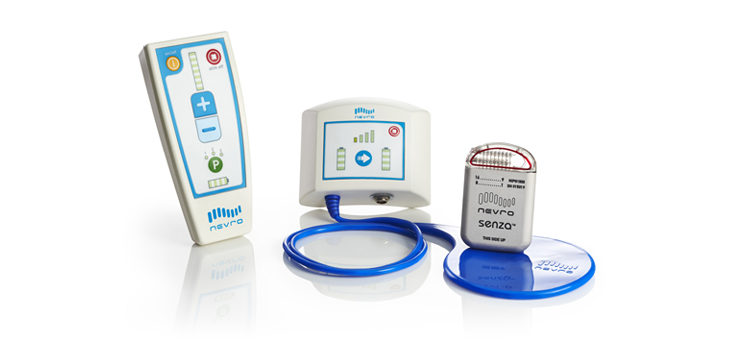
Nevro Corp announced two European CE mark approvals in the month of November for expanded imaging labeling of the company’s Senza Spinal Cord Stimulation (SCS) system.
Nevro Corp Spine Stimulator Receives Expanded CE Marks
2 min read Premium comments
Secondary
The first mark announced on November 15, 2017, was for the company’s full-body magnetic resonance imaging (MRI) conditional labeling on the Senza SCS system delivering HF10 Therapy. The second, on November 30, was for the company’s next-generation Senza II SCS system delivering the same therapy through a smaller implantable pulse generator (IPG).
The company was quick to point out the non-opioid nature of the therapy.
According to the company, the therapy delivers electrical pulses to the spinal cord to alleviate pain. The pulses are “delivered by small electrodes on leads that are placed near the spinal cord and are connected to a compact, battery-powered generator implanted under the skin. HF10 therapy is the only SCS therapy indicated to provide pain relief without paresthesia (a stimulation-induced sensation, such as tingling or buzzing, which is the basis of traditional SCS) and is also the first SCS therapy to demonstrate superiority to traditional SCS for back and leg pain in a comparative pivotal study.”
The Senza and Senza II systems and HF10 therapy, says the company, “are covered by more than 140 issued U.S. and international patents.”
The company said the November CE mark adds to the previous labeling allowing head and extremity MRI scans, “broadening the pool of patients who are eligible to receive the Senza SCS System, including both model IPG1000 and IPG1500.” That “approval was retroactive, so that “the new labeling for expanded imaging applies to all patients currently implanted with the Senza SCS system with percutaneous leads.”
Mohammad Maarouf, M.D., associate professor and head of the Department of Stereotaxy and Function Neurosurgery at Cologne Merheim Medical Center, University of Witten/Herdecke, Germany, said the HF10 therapy is “life-changing” for his patients. “I am happy that all of my patients past and future now have access to superior outcomes with the reassurance that patients with percutaneous systems can safely have a full-body MRI should the need arise.”
The company is based in Redwood City, California, and says it explored stimulators beyond traditional SCS frequencies (40–60 Hz).
HF10 therapy, says the company, came about as the result of combining high frequency at 10 kHz “with a unique waveform and a specific treatment algorithm.” The result is a “paresthesia-free treatment proven to provide more pain relief to more patients in more pain areas.”
The Senza system received CE mark in 2010, TGA (Therapeutic Goods Administration) approval in Australia in 2011, FDA clearance in 2015, and is commercially available in Europe, Australia, and the U.S.
Author
React:
Discussion
This is a fascinating development. In my practice we've seen similar outcomes with the revised protocol. The key differentiator seems to be patient selection criteria. Has anyone else noticed the correlation with BMI thresholds?
Great point. I'd push back slightly on the conclusion, the sample size in the cited study is too small to draw population-level inferences. That said, the directional signal is compelling and worth a larger RCT.
We implemented a similar approach last year. Early results are promising but we're still gathering 12-month follow-up data. Happy to share our protocol if anyone is interested.
Join the conversation
Orthopedic professionals are discussing this. Sign in and upgrade to read every comment and add your voice.