
Medovex Corporation is hoping to start a U.S. clinical trial in the near future for its DenerveX System.
Medovex Corp Submits Facet Pain Relief IDE
1 min read Premium comments
Secondary
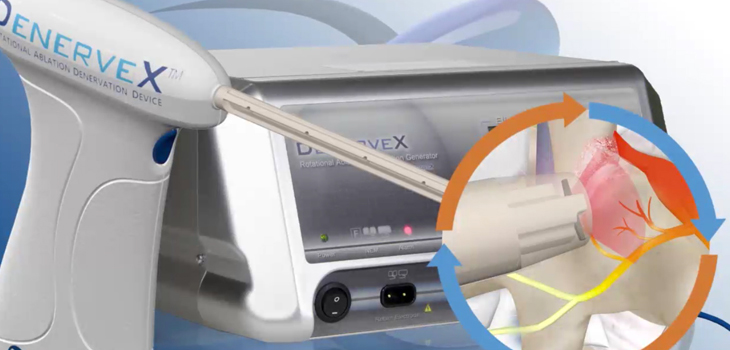
According to a November 27, 2017 company statement announcing the submission of an Investigational Device Exemption (IDE) request to the FDA, the system is a non-addictive, non-opioid drug alternative, “designed for enduring relief of Facet Joint Syndrome related to chronic back pain.”
The DenerveX System is not yet available in the U.S., but is “…CE Marked in Europe and commercially available in certain other international markets.”
RF Denervation Device
The company says the system “…is a rotational, monopolar, radiofrequency [RF] denervation device, powered by a dedicated DenerveX Pro-40 generator. It is designed to ablate the nerve and capsular tissue on the posterior surface of the facet joint. Denervation is achieved through Rotacapsulation, a combination of high heat and rotational tissue shaving.”
The procedure, according to the company, “…denervates and removes capsular tissue from the Facet Joint in one single procedure. Treatment results from the combined effect of a deburring or polishing action and RF ablation treatment on the joint. The slowly rotating burr removes the targeted facet joint synovial membrane and joint surface while the heat ablation destroys tissue and denudes any residual nervous and synovial membrane overlying the joint, removing the end point sensory tissue of the joint.”
Each device is provided in a procedure tray with “…a 1mm K-wire, Procedure Dilator, Portal Tube, Portal Driver and Tissue Stabilizer…accessories are designed for single-use and provided sterile.”
Potential Clinical Trial
Jill Schweiger, Sr. Vice President Regulatory and Clinical Affairs for Medovex said, “The submission of the IDE marks a major milestone…the company has been preparing for this moment for the past four years.”
“Significant time, effort and resources have been invested in what we believe will be a successful submission and review by the FDA, followed by a U.S. clinical trial in the future.”
Author
React:
Discussion
This is a fascinating development. In my practice we've seen similar outcomes with the revised protocol. The key differentiator seems to be patient selection criteria. Has anyone else noticed the correlation with BMI thresholds?
Great point. I'd push back slightly on the conclusion, the sample size in the cited study is too small to draw population-level inferences. That said, the directional signal is compelling and worth a larger RCT.
We implemented a similar approach last year. Early results are promising but we're still gathering 12-month follow-up data. Happy to share our protocol if anyone is interested.
Join the conversation
Orthopedic professionals are discussing this. Sign in and upgrade to read every comment and add your voice.