
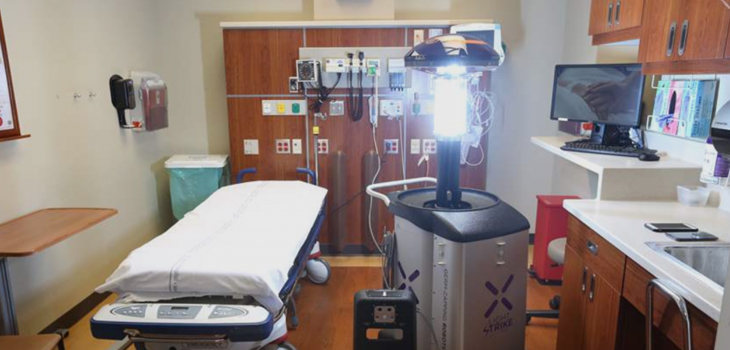
The last thing a surgical team wants is a germy OR. To the rescue is San Antonio, Texas-based Xenex Disinfection Services LLC’s Germ-Zapping Robot.
Germ Zapping Robot Coming to OR Near You?
2 min read Premium comments
Secondary
A new study from MD Anderson indicates that a system known as the Xenex LightStrike Germ-Zapping Robot can help rid the OR of the pathogens that can lead to surgical site infections (SSIs).
In novel work, researchers from the University of Texas MD Anderson Cancer Center and the H. Lee Moffitt Cancer Center and Research Institute in Tampa, Florida, evaluated OR surfaces between surgical cases in the OR. “Evaluation of a pulsed xenon ultraviolet disinfection system to decrease bacterial contamination in operating rooms,” was published in the October 10, 2017 edition of BMC Infectious Diseases.
Roy F. Chemaly, M.D., M.P.H., professor in MD Anderson’s Department of Infectious Diseases, Infection Control and Employee Health, Division of Internal Medicine and co-author on the study, told OTW, “Studies have shown that contamination in the OR increases with sequential cases and may lead to a more contaminated environment for each subsequent patient during operative hours. We wanted to determine if rapid and effective between-case cleaning could reduce environmental contamination in the OR.”
The authors wrote, “In this study, 5 high-touch surfaces in 30 ORs were sampled after manual cleaning and after PX-UV [pulsed xenon-ultraviolet] intervention mimicking between-case cleaning to avoid the disruption of the ORs’ normal flow. The efficacy of a 1-min, 2-min, and 8-min cycle were tested by measuring the surfaces’ contaminants by quantitative cultures using Tryptic Soy Agar contact plates.”
A company representative told OTW, “What makes the LightStrike robot unique is its use of pulsed xenon (an inert gas) to make intense UV light and not mercury bulbs.”
“Mercury bulb UV has been around for many years and there are about 50 companies that manufacture mercury UV devices.”
“Pulsed xenon UV works faster than mercury UV light and is scientifically different than UV light generated by mercury UV devices. We’re the only pulsed xenon UV disinfection robot on the market and to date, the only SSI reduction data credited to UV disinfection and published in a peer-reviewed journal is from hospitals using Xenex pulsed xenon (non-mercury bulb) UV technology.”
Dr. Chemaly commented to OTW, “We found that the two-minute cycle of intense pulsed xenon ultraviolet disinfection was effective in reducing colony counts when performed after standard cleaning.”
“With only a two-minute cycle and significant reduction of bacterial contamination on high touch surface areas in the OR, it becomes appealing to implement this protocol between surgical cases and follow the impact on SSIs. Incorporating the pulsed xenon UV disinfection into our daily cleaning processes in the ORs may have an impact on the rates of SSIs.”
Author
React:
Discussion
This is a fascinating development. In my practice we've seen similar outcomes with the revised protocol. The key differentiator seems to be patient selection criteria. Has anyone else noticed the correlation with BMI thresholds?
Great point. I'd push back slightly on the conclusion, the sample size in the cited study is too small to draw population-level inferences. That said, the directional signal is compelling and worth a larger RCT.
We implemented a similar approach last year. Early results are promising but we're still gathering 12-month follow-up data. Happy to share our protocol if anyone is interested.
Join the conversation
Orthopedic professionals are discussing this. Sign in and upgrade to read every comment and add your voice.