
FH Orthopedics has announced that sales of its Cervical Prosthesis (CP-ESP) and Lumbar Prosthesis (LP-ESP) have exceeded 6,000 units.
FH’s ESP Disc Hits 6,000th Implant Milestone
1 min read Premium comments
Secondary
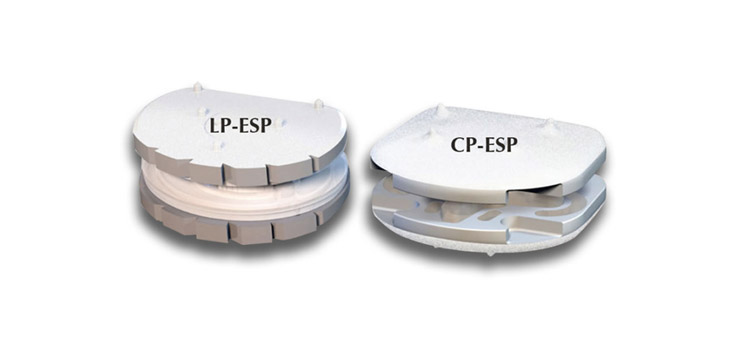
According to the company, “ESP discs combine two titanium end plates with an elastomeric cushion made of polycarbonate urethane. This structure imitates the natural disc, in which bony segments are connected by a spongy disc that provides flexibility while withstanding the pressures of compression and torsion.”
“Specific features of the end plates—short spikes, a rough outer surface, and a coating of hydroxyapatite (HA), which is proven to enhance bone ingrowth—help to ensure stability and bony fixation of the implant over time.”
“This design provides a number of benefits for orthopedic surgeons and their patients: Adaptive center of rotation, shock absorbing, improved stability, no surface bearing for increased lifetime, designed to fit and restore patient lordosis (spinal curvature), range of sizes to fit different patients, minimally invasive surgical technique and shorter hospital stay.”
“The CP-ESP prosthesis—indicated for use in cases of symptomatic cervical discopathy that have not responded to other medical treatments for at least six months—offers 7 degrees of flexion/extension, 5 degrees of lateral flexion, and 4.5 degrees of axial rotation. The LP-ESP prosthesis—indicated for use in cases of lumbar disc disease, typically related to disc herniation, that have not responded satisfactorily to other treatments—offers 6 degrees of flexion/extension, lateral flexion, and axial rotation.”
Spine Business Unit Director Eric Hermann told OTW, “This milestone means that we get a great market recognition for our advanced technology of viscoelastic prosthesis which allows surgeons to avoid compromising when they treat their patients. Due to its technology, the ESP prosthesis provides similar properties to natural disc. It allows six degrees of freedom while offering resistance as the natural disc.”
“This level—6,000 prosthesis since the start (lumbar CE mark in 2006, cervical CE mark in 2012) and half of them within the last three years—means more than 30% growth per year. We plan, at least, to triple this number in the next five years. We also have plans to start to offer the ESP prosthesis in the U.S. and are currently working on an action plan to get FDA approval.”
Author
React:
Discussion
This is a fascinating development. In my practice we've seen similar outcomes with the revised protocol. The key differentiator seems to be patient selection criteria. Has anyone else noticed the correlation with BMI thresholds?
Great point. I'd push back slightly on the conclusion, the sample size in the cited study is too small to draw population-level inferences. That said, the directional signal is compelling and worth a larger RCT.
We implemented a similar approach last year. Early results are promising but we're still gathering 12-month follow-up data. Happy to share our protocol if anyone is interested.
Join the conversation
Orthopedic professionals are discussing this. Sign in and upgrade to read every comment and add your voice.