
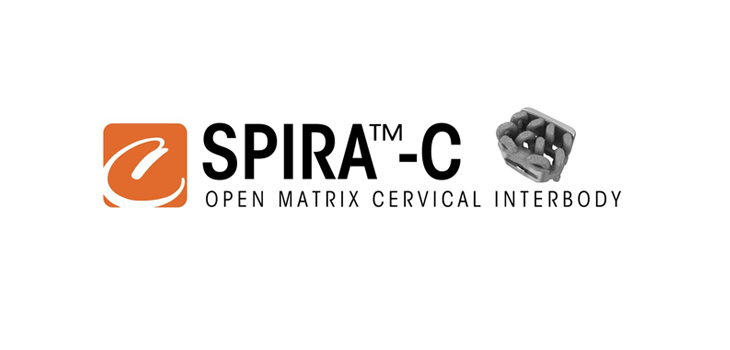
Following FDA 510(k) clearance in August of its Spira Open Matrix ALIF device for use in skeletally mature patients with degenerative disc disease (DDD) at one or two contiguous levels from L2-S1, Camber Spine Technologies, LLP, announced clearance of its Spira-C Open Matrix Cervical Interbody device on December 7, 2017.
FDA Clears Camber Spine’s Cervical Fusion Device
2 min read Premium comments
Secondary
“The Spira-C,” according to the company, “is indicated for use at one or two contiguous levels in the cervical spine, from C3-C7, in skeletally mature patients who have had six weeks of non-operative treatment for the degenerative disk disease (DDD) with up to Grade 1 spondylolisthesis….The device is intended to be used with additional FDA-cleared supplemental fixation systems.”
The device uses the company’s arched design as well as “Surface by Design™” technology.
According to the company, its interbody implants represent “the next generation of open architecture; 3-D printed, titanium implants designed to enhance fusion. The combination of smart science and smart surfaces merged with SPIRA™ Arch Technology creates an optimal environment for cell proliferation and bone growth.”
Daniel Pontecorvo, the company’s CEO, said “…engineers and designing surgeons leveraged the latest in 3-D printing technology to incorporate the needs at each step of the fusion process.” He said “…significant friction was achieved with the unique surface design to enable “immediate” stability.”
“For short-term stability,” he continued, “other features were added to the surface design. This includes both a roughened titanium surface designed to promote bone cell proliferation, and a pore size optimized for bone ingrowth.”
“In a way, robust ingrowth achieves a ‘mechanical fusion’, where we expect patients to feel better quicker.”
“Lastly,” he added that long-term stability is achieved with the “ultimate endplate-to-endplate fusion. The newly forming bone follows the multiple arches incorporated with the Surface By Design™ to encourage ongrowth and ingrowth throughout the cage. Also, using a key bone-growth principal called ‘Wolff’s Law’, the arched design structure enables the distribution of load and strain, helping to enhance the fusion.”
The private company was founded in 2010 by Pontecorvo working in sales and distribution for Synthes and then becoming an exclusive distributor in the Mid-Atlantic region for Globus Medical, Inc.. The company’s vice president of sales is Paul Sendro, a well-known and seasoned spine and orthopedics veteran.
Author
React:
Discussion
This is a fascinating development. In my practice we've seen similar outcomes with the revised protocol. The key differentiator seems to be patient selection criteria. Has anyone else noticed the correlation with BMI thresholds?
Great point. I'd push back slightly on the conclusion, the sample size in the cited study is too small to draw population-level inferences. That said, the directional signal is compelling and worth a larger RCT.
We implemented a similar approach last year. Early results are promising but we're still gathering 12-month follow-up data. Happy to share our protocol if anyone is interested.
Join the conversation
Orthopedic professionals are discussing this. Sign in and upgrade to read every comment and add your voice.