
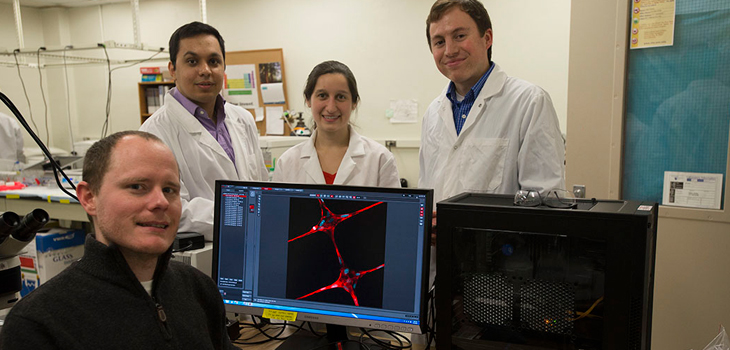
Engineers from Pennsylvania State University believe they have found a way to create the structural framework for growing living tissue using an off-the-shelf, hobbyist 3-D printer.
Engineer Used Hobbyist 3-D Printer to Grow Human Tissue
1 min read Premium comments
Secondary
At present, nearly all transplant tissues, such as hearts and tendons, come from living or dead donors. These researchers are looking for a way to create replacement tissues by using inexpensive and available methods. Their hope is to grow replacement tissues using a 3–D printer and electrospinning to produce a scaffold for tissues that could support the production of combined muscles and tendons, or tendons and cartilage.
Electrospinning, is a process that uses an electric charge to spin nanometer threads from either a polymer melt or a solution.
“We are trying to make stem-cell-loaded hydrogels reinforced with fibers like the rebar in cement,” said Justin L. Brown, Ph.D., associate professor of biomedical engineering. “If we can lend some structure to the gel, we can grow living cells in defined patterns and eventually the fibers will dissolve and go away
“The idea is that if we could multiplex electrospinning with a collagen gel and bioprinting, we could build large and complex tissue interfaces, such as bone to cartilage,” said doctoral student researcher Pouria Fattahi. “Others have created these combination tissues using a micro-extrusion bioprinter.”
Current strategies create the different tissues separately and then combine them using some type of adhesive or connector. However, in the body, tissues such as cartilage and bone, and tendons and muscles, grow together seamlessly. The researchers explain that if two different tissues—muscle and tendon—are needed, the 3-D printer can alter the pattern of threads in such a way that the transition could be seamless, resulting in a naturally formed, two-part tissue replacement.
The research has been published in the Journal of Advanced Healthcare Materials.
Author
React:
Discussion
This is a fascinating development. In my practice we've seen similar outcomes with the revised protocol. The key differentiator seems to be patient selection criteria. Has anyone else noticed the correlation with BMI thresholds?
Great point. I'd push back slightly on the conclusion, the sample size in the cited study is too small to draw population-level inferences. That said, the directional signal is compelling and worth a larger RCT.
We implemented a similar approach last year. Early results are promising but we're still gathering 12-month follow-up data. Happy to share our protocol if anyone is interested.
Join the conversation
Orthopedic professionals are discussing this. Sign in and upgrade to read every comment and add your voice.