
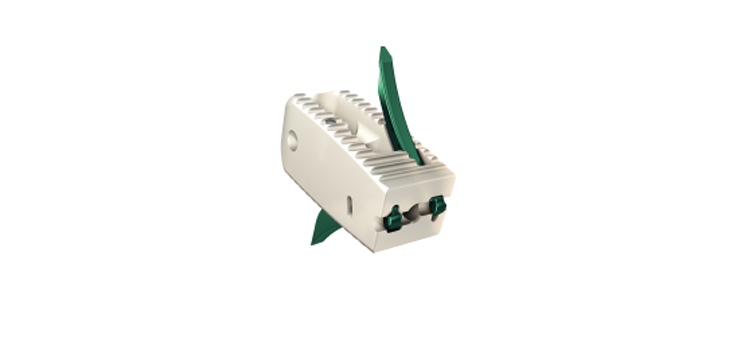
Zimmer Biomet Holdings, Inc. has announced the U.S. launch of its Avenue T TLIF Cage.
Zimmer Biomet Launch’s New Cage With VerteBRIDGE Plating
2 min read Premium comments
Secondary
As the company wrote in its news release, “Avenue T advances posterior lumbar cage technology by incorporating VerteBRIDGE plating, which facilitates simplified cage insertion and zero-profile, intradiscal fixation through a direct, minimally invasive surgical (MIS) approach.”
“Avenue T is the first and only posteriorly implanted cage with integrated, anti-migration fixation, solidifying Zimmer Biomet as the first company to offer a suite of lumbar cages with integrated fixation for every fusion approach. Avenue T joins a family of cages with VerteBRIDGE plating, including ROI-C Cervical Cage, Avenue L Lateral Lumbar Cage and ROI-A ALIF Cage.”
Craig Chebuhar, M.D., a board-certified orthopedic spine surgeon in Atlanta, Georgia, who implanted one of the first Avenue T cages in the U.S., commented, “I regularly use Zimmer Biomet’s ROI-C Cervical Cage featuring VerteBRIDGE plating in my practice. Transforaminal lumbar surgery is another attractive application for integrated plating. For my TLIF patients, I appreciate the additional fixation VerteBRIDGE provides to the construct, all via a minimally invasive approach.”
The company news release stated: “The Avenue T TLIF Cage system is indicated for intervertebral body fusion of the lumbar spine, from L2 to S1, in skeletally mature patients who have had six months of non-operative treatment.”
“The device is intended for use at either one level or two contiguous levels for the treatment of degenerative disc disease (DDD) with up to Grade I spondylolisthesis or retrolisthesis. DDD is defined as back pain of discogenic origin with degeneration of the disc confirmed by history and radiographic studies. The Avenue T TLIF Cage is designed for use with or without integrated fixation and must be used in conjunction with supplemental fixation cleared by FDA for use in the lumbar spine. The device is implanted via a transforaminal approach and intended for use with autograft to facilitate fusion.”
Jon Quinn, thoracolumbar fixation marketing director, told OTW, “During the development of the Vital Spinal System, the team successfully balanced the selection of comprehensive instruments for degenerative thoracolumbar fusion cases with the goal of reducing sterilization costs.”
“The comprehensive Vitality+ Spinal Fixation System consists of Vitality+ POWER for simple, controlled pedicle preparation and pedicle screw insertion, Vitality+ PSO for optimal pedicle subtraction osteotomy and vertebral column resection procedures, and Vitality+ HOOKS with an extensive array of additional fixation options. In addition, the Vital Spinal Fixation System offers a compact solution for degenerative thoracolumbar procedures with its convenient, intuitive and optimized two-kit pedicle screw instrument configuration.”
Author
React:
Discussion
This is a fascinating development. In my practice we've seen similar outcomes with the revised protocol. The key differentiator seems to be patient selection criteria. Has anyone else noticed the correlation with BMI thresholds?
Great point. I'd push back slightly on the conclusion, the sample size in the cited study is too small to draw population-level inferences. That said, the directional signal is compelling and worth a larger RCT.
We implemented a similar approach last year. Early results are promising but we're still gathering 12-month follow-up data. Happy to share our protocol if anyone is interested.
Join the conversation
Orthopedic professionals are discussing this. Sign in and upgrade to read every comment and add your voice.