
Stryker’s Spine division has just launched its innovative Serrato pedicle screw.
Stryker Spine Launches Serrato Pedicle Screw
1 min read Premium comments
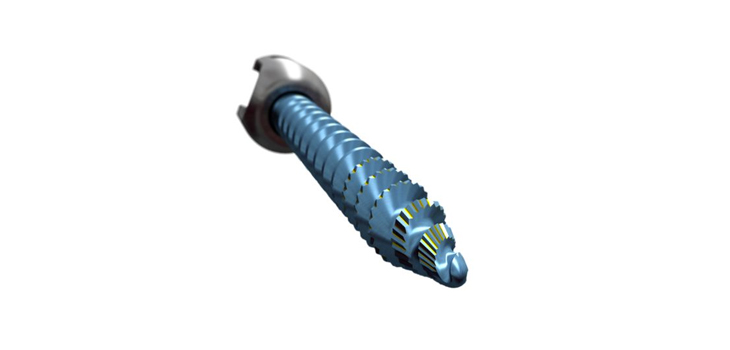
Secondary
For those who attended the recent North American Spine Society (NASS) meeting in Orlando, the new design was prominently displayed in the booth.
According to Stryker, “The Serrato pedicle screw is the first dual-thread screw with enhanced cutting flutes (serrations) that are designed to reduce work by lowering the insertion torque, and True-Tip geometry, which allows for precise insertion and immediate bone engagement.”
“We are thrilled to announce the full commercial launch of the Serrato pedicle screw during this important spinal surgery conference,” said Bradley Paddock, president of Stryker’s Spine division. “We have been receiving exceptional feedback from our surgeon customers since the initial launch and are excited to now make Serrato more broadly available to surgeons.”
Alexander R. Vaccaro, M.D., Ph.D., M.B.A., one of the first surgeons to integrate Serrato, added, “The Serrato pedicle system from Stryker has added a new level of versatility to the armamentarium that a spine surgeon has in all complex spinal procedures. The new screw design affords excellent screw purchase.”
A company representative told OTW, “A hands-on demonstration at NASS allowed surgeons to see how the Serrato pedicle screw is designed with the goal of reducing work, increasing speed, and enhancing surgical efficiency. The response from surgeons was overwhelmingly positive.”
Author
React:
Discussion
This is a fascinating development. In my practice we've seen similar outcomes with the revised protocol. The key differentiator seems to be patient selection criteria. Has anyone else noticed the correlation with BMI thresholds?
Great point. I'd push back slightly on the conclusion, the sample size in the cited study is too small to draw population-level inferences. That said, the directional signal is compelling and worth a larger RCT.
We implemented a similar approach last year. Early results are promising but we're still gathering 12-month follow-up data. Happy to share our protocol if anyone is interested.
Join the conversation
Orthopedic professionals are discussing this. Sign in and upgrade to read every comment and add your voice.