
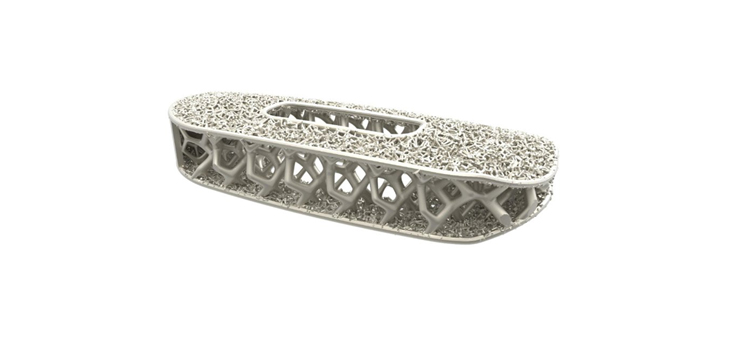
San Diego, California-based NuVasive, Inc. has launched its Modulus XLIF titanium implants.
NuVasive Launches 3D-Printed Porous Titanium Implant
1 min read Premium comments
Secondary
According to NuVasive’s October 18, 2017 news release, “The new 3D-printed, fully porous device provides a differentiated offering for the company’s flagship XLIF [lateral lumbar interbody fusion] procedure, highlighting a continued commitment to innovation in developing first-of-its-kind technology to support its leading lateral spine procedure.”
“We’ve seen an increase in surgeon preference to use titanium interbody options in spine surgeries, and we were confident we could develop a titanium option that delivers the porous properties surgeons need,” said Matt Link, NuVasive executive vice president of strategy, technology and corporate development.
“Modulus XLIF maximizes the potential of 3D-printed spinal implants through the application of unique and advanced software optimization processes. This product launch further represents our continued commitment to advancing surgical materials, and delivering best-in-class implants that provide superior osseointegration and biomechanics.”
“The new Modulus titanium implants are developed using additive manufacturing technology, or 3D printing, to create an organic, porous architecture that mimics the porosity and stiffness of bone for reduced stress shielding. By employing advanced microporous surface topography, Modulus XLIF creates an ideal environment for bone in-growth. The device’s optimized architecture also leads to improved imaging characteristics compared to traditional titanium interbody devices.”
Matt Link told OTW, “What is particularly interesting working with titanium is how crucial the heat treatment of the metal is to the process. The correct heating of titanium is critical to establish uniform and consistent mechanical properties.”
“The majority of metallic medical devices are manufactured using traditional subtractive manufacturing processes (mill, lathe, etc.). The Modulus implant is manufactured predominately with additive manufacturing (Powder Bed Fusion, specifically) as the architecture of the implant is quite complex and unable to be machined with traditional methods.
The implants also go through traditional manufacturing steps to provide more precise features and finishes. Strict handling and subsequent cleaning processes must also be followed in order to ensure these highly porous structures are adequately cleaned.”
Author
React:
Discussion
This is a fascinating development. In my practice we've seen similar outcomes with the revised protocol. The key differentiator seems to be patient selection criteria. Has anyone else noticed the correlation with BMI thresholds?
Great point. I'd push back slightly on the conclusion, the sample size in the cited study is too small to draw population-level inferences. That said, the directional signal is compelling and worth a larger RCT.
We implemented a similar approach last year. Early results are promising but we're still gathering 12-month follow-up data. Happy to share our protocol if anyone is interested.
Join the conversation
Orthopedic professionals are discussing this. Sign in and upgrade to read every comment and add your voice.