
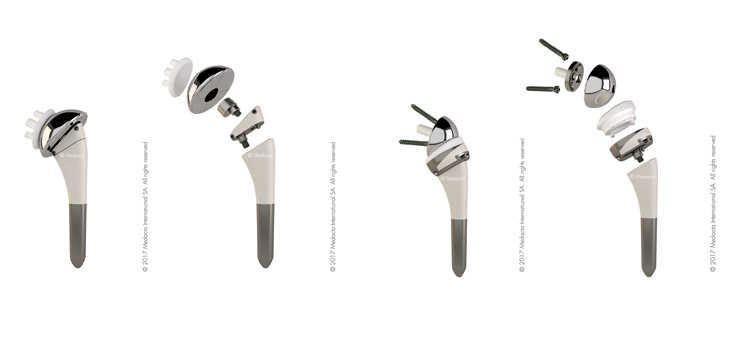
Swiss family-owned Medacta International has received clearance from the FDA to market its Anatomic Shoulder and Reverse Shoulder components of its modular shoulder system in the U.S.
Medacta Anatomic and Reverse Shoulder Components Cleared
1 min read Premium comments
Secondary
The company also announced on October 26, 2017 that the first surgery in the U.S. of the device was performed by Matthew Saltzman, M.D., associate professor of orthopaedic surgery at the Northwestern Memorial Hospital in Chicago, Illinois.
Saltzman said the procedure “went very well.” He added that the system’s instrumentation and implants allow for “impressive anatomic restoration, resulting in an efficient surgery and, hopefully, improved patient outcomes.”
The company says the system features a broad range of options, including wide-ranging sizes, adjustable offset, and innovative configurations developed by an international team of expert surgeons. The platform, states the company, “offers modularity and compatibility…while still respecting anatomic conversion from primary to reverse.”
Predicates and Indications
The clearance notification for the reverse shoulder was filed in February 2017 and revised in early September. The primary predicate device was DePuy Orthopaedics Inc.’s Delta Xtend Reverse Shoulder System and Modular Stem.
The device is indicated for treatment of humeral fractures and for primary or revision total shoulder replacement in patients with a grossly deficient rotator cuff shoulder joint with severe arthropathy or a previously failed joint replacement and a grossly rotator cuff deficient shoulder joint.
The anatomic shoulder notification was filed on July 17, 2017. The primary predicate device was Synthes’ Epoca Shoulder Prosthesis System.
The device is indicated for treatment of humeral fractures and for primary or revision total shoulder replacement in patients with an intact or reparable rotator cuff shoulder joint, severe arthropathy or a previously failed joint replacement.
The shoulder system was unveiled in February 2017 following its first ever surgery in Europe.
Author
React:
Discussion
This is a fascinating development. In my practice we've seen similar outcomes with the revised protocol. The key differentiator seems to be patient selection criteria. Has anyone else noticed the correlation with BMI thresholds?
Great point. I'd push back slightly on the conclusion, the sample size in the cited study is too small to draw population-level inferences. That said, the directional signal is compelling and worth a larger RCT.
We implemented a similar approach last year. Early results are promising but we're still gathering 12-month follow-up data. Happy to share our protocol if anyone is interested.
Join the conversation
Orthopedic professionals are discussing this. Sign in and upgrade to read every comment and add your voice.