
Ankle repair start-up company Mortise Medical announced FDA 510(k) clearance of its SyndesMetrics Syndesmosis repair system on November 14, 2014.
FDA Clears Mortise Medical Ankle Repair System
1 min read Premium comments
Secondary
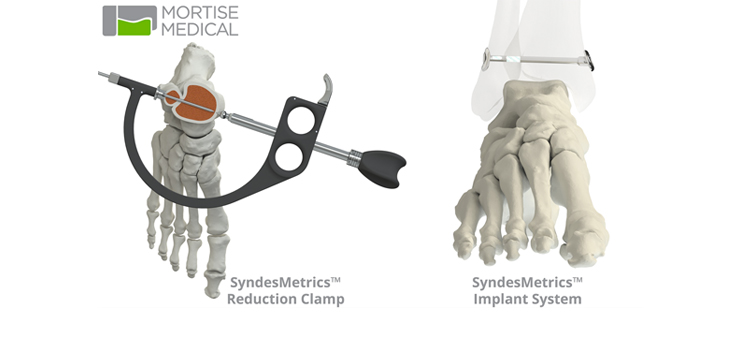
The Logan, Utah-based company stated the system was developed to address three clinical needs for syndesmotic disruption injuries: predictable and repeatable anatomic reduction, restoration of physiological motion, and restoration of ankle stability.
According to the company, anatomic reduction is achieved using a reduction clamp, which features: anatomic referencing clamp points; precision, surgeon controlled, calibrated clamping force; and an integrated drill guide to prepare the bone for the implant system. Both the reduction clamp and implant system are compatible with distal fibula plating systems.
Also, the implant system features minimal hardware prominence, no suture prominence and a reversible locking mechanism for securing the high strength suture tape that connects the tibial and fibular implant components.
Biomechanical testing was performed on matched pair human cadaveric ankle specimens at the University of Iowa. The implant system, according to the company, “was found to more closely reproduce normal physiological ankle motion when compared to a 4.5mm cortical screw or a suture button construct.”
Additionally, says the company, mechanical testing conducted by a third party medical device testing company demonstrated that the system’s repair constructs “had higher static strength and higher fatigue strength than 3.5mm cortical screw or suture button repair constructs.”
Charles Saltzman, M.D., professor and chairman of orthopaedics at the University of Utah and immediate past president of the International Federation of Foot and Ankle Societies, said, “Surgeons will find this innovative system more intuitive to use and more reproducible for positioning and tensioning the distal tibiofibular syndesmosis than anything we now have available.”
Mortise Medical is incubated and operated by Surgical Frontiers.
Author
React:
Discussion
This is a fascinating development. In my practice we've seen similar outcomes with the revised protocol. The key differentiator seems to be patient selection criteria. Has anyone else noticed the correlation with BMI thresholds?
Great point. I'd push back slightly on the conclusion, the sample size in the cited study is too small to draw population-level inferences. That said, the directional signal is compelling and worth a larger RCT.
We implemented a similar approach last year. Early results are promising but we're still gathering 12-month follow-up data. Happy to share our protocol if anyone is interested.
Join the conversation
Orthopedic professionals are discussing this. Sign in and upgrade to read every comment and add your voice.