
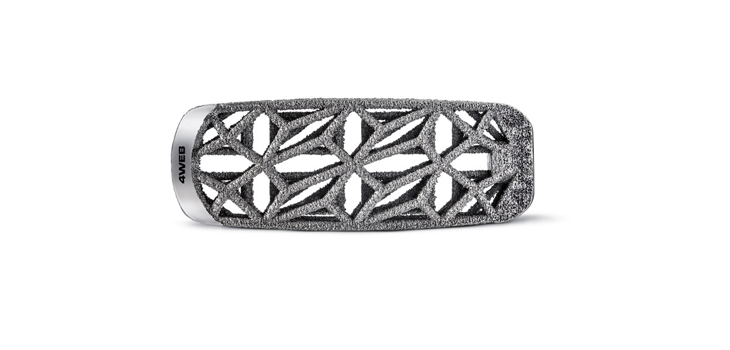
Orlando, Florida-based 4WEB Medical has announced the results of a new study demonstrating reduced subsidence for its Lateral Spine Truss System (LSTS) as compared to annular interbody implant designs at the recent annual meeting of the North American Spine Society.
4WEB Medical’s LSTS: Increased Subsidence Resistance
1 min read Premium comments
Secondary
The study was led by Vijay Goel, Ph.D. at the University of Toledo.
According to the company, “4WEB’s proprietary open architecture truss design increases endplate to implant contact maximizing resistance to subsidence. The additive manufacturing process for truss technology provides a hierarchal surface roughness spanning from the nano to macro scale which may contribute to stimulating an osteogenic response.”
“Our biomechanical testing showed the 4WEB 18mm wide, 40mm long LSTS implant performed better in resisting subsidence than the competitive 21mm wide, 60mm long annular design lateral device. This finding was consistent across all density foam blocks tested. These results are indicative of the optimized load distribution that is inherent to the 4WEB truss implant technology,” said Dr. Goel.
Dr. Goel told OTW, “Historically, clinical research has shown that subsidence resistance is a function of implant footprint or surface area and is directly proportional, meaning the larger the implant the more resistant to subsidence.”
“However, our preliminary research has shown that implant design plays a much more important role in resisting subsidence. With this study, we have been able to demonstrate that the truss design of the 4WEB cage distributes the load more evenly across its endplate contact surface thereby increasing resistance to subsidence as compared to traditional annular devices.”
“It is important for surgeons to carefully consider implant design with regards to subsidence, particularly when the anatomy or the surgical approach limit the size of interbody that can be safely implanted. Furthermore, implants designed for subsidence resistance and load distribution like the 4WEB cage should be considered for high risk patients such as smokers or those with osteoporosis to decrease the risks associated with subsidence and increase the potential for fusion.”
Author
React:
Discussion
This is a fascinating development. In my practice we've seen similar outcomes with the revised protocol. The key differentiator seems to be patient selection criteria. Has anyone else noticed the correlation with BMI thresholds?
Great point. I'd push back slightly on the conclusion, the sample size in the cited study is too small to draw population-level inferences. That said, the directional signal is compelling and worth a larger RCT.
We implemented a similar approach last year. Early results are promising but we're still gathering 12-month follow-up data. Happy to share our protocol if anyone is interested.
Join the conversation
Orthopedic professionals are discussing this. Sign in and upgrade to read every comment and add your voice.