
John Lucas, M.D., the head of the Spartanburg Regional Healthcare System’s Sports Medicine Institute, has started a new project with Clemson University’s International Center for Automotive Research that will study the driving capabilities of concussed students.
Should Teens With Concussion Be Driving?
3 min read Premium comments
Secondary
“About one-tenth of the cases I see are concussions,” said Lucas, “I was wondering if there could be a connection between the number of teenagers suffering from concussions and the fact that the number one killer of teenagers in the U.S. is motor vehicle crashes.”
“We know the presentation [of concussions] can vary,” he said. “We want to find out if there are deficits. When should they go back behind the wheel? There’s next to no literature out there about this.”
Lucas initial research led him to poll other physicians only to find out that they were as uncertain as he was about the protocol for driving after a concussion.
Lucas said he noticed a gap in National Football League examinations a few years ago. “We have intensive protocols for when [student athletes] should return to play, or return to the classroom, but nothing for this,” he said. “They leave the office, get behind the wheel of a car, and drive home. …It all falls back on the shoulders of the physician. I still don’t have protocols to go off of. I’m hoping to at least raise the question.”
Lucas hopes to answer the question with the findings of a new research project he is conducting in partnership with Clemson University’s International Center for Automotive Research (CU-ICAR).
In 2014, Lucas was part of a group of Spartanburg Regional physicians who visited CU-ICAR’s facility in Greenville, South Carolina. It was there he met Johnell Brooks, Ph.D., an associate professor who, for several years, had been working with an interdisciplinary team to develop driving simulators focused on rehabilitation in a clinical setting.in partnership with Utah-based DriveSafety. The two quickly realized that they were on parallel paths and could help each other.
In 2016, the Spartanburg Regional Foundation awarded a $75,000 grant to support the purchase of two driving simulators. They placed one in Lucas’ office and the other at the YMCA. The designers worked closely with Lucas and his team to tailor the driving simulators to meet their needs.
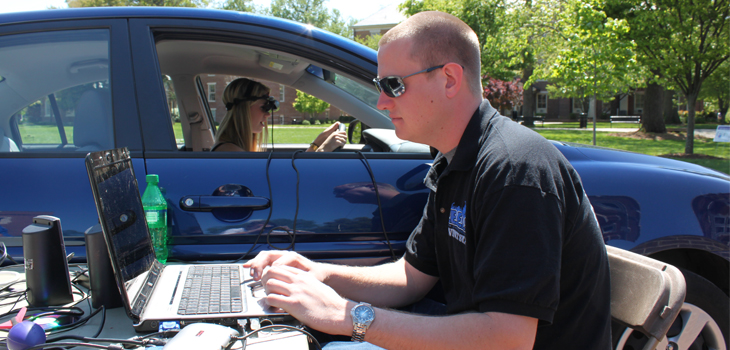
Lucas said the optimal age range for his study is 15 to 22 years old. The simulator puts patients through a variety of basic tests that measure reaction times, response to visual cues, and other cognitive aspects of driving.
He has already put several patients through the simulator and said the results show promise for his research.
“The typical reaction time [for a healthy driver to put on the brakes] is about a half second,” Lucas said. “I had one girl that took 2.5 seconds. And the scariest part about it was she said, ‘I thought I was doing good.’”
Travis Dewyea, rehabilitation manager for SRHS’s Rehabilitation Services, said the simulator at the YMCA will be used to study the impacts of a variety of factors, such as cerebrovascular disease, chemotherapy, neuropathy, and musculoskeletal injuries, on driving.
“CU-ICAR is one of the world leaders in automotive research,” Dewyea said. “We’re truly grateful to have them as a partner. …For us, one of the most exciting things about this is that it’s leveraging technology to help manage someone’s rehabilitation.”
According to writer Trever Anderson with the Upstate Business Journal, Lucas hopes his research will lead to protocols that help doctors determine when a patient should return to driving after a concussion. He also doesn’t want to unnecessarily restrict anyone based on knee-jerk reactions that aren’t based on facts.
“As far as I know, we’re the first to do this,” Lucas said. “The sky is the limit.”
Author
React:
Discussion
This is a fascinating development. In my practice we've seen similar outcomes with the revised protocol. The key differentiator seems to be patient selection criteria. Has anyone else noticed the correlation with BMI thresholds?
Great point. I'd push back slightly on the conclusion, the sample size in the cited study is too small to draw population-level inferences. That said, the directional signal is compelling and worth a larger RCT.
We implemented a similar approach last year. Early results are promising but we're still gathering 12-month follow-up data. Happy to share our protocol if anyone is interested.
Join the conversation
Orthopedic professionals are discussing this. Sign in and upgrade to read every comment and add your voice.