
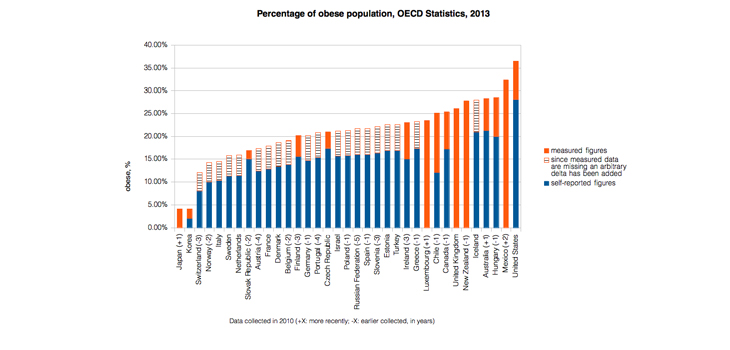
If the World Obesity Federation’s researchers are correct in their estimates, eight years from today obesity will cost the world’s health systems 1.2 trillion dollars. In eight years, they say, a third of the population of the world will be obese.
One-third of World Will be Obese in Eight Years
1 min read Premium comments
Secondary
The World Obesity Federation has added in to its calculations, not just cancer, diabetes and heart disease to reach that heart-stopping total of $1.2 trillion, but also the cost of hip, knee and back complications associated with carrying extra weight.
The adult statistics in the United States are sobering. A third of men are obese and more than a third of women are carrying too much weight. Over a quarter million school children are obese.
According to a writer for Spark Lab, America’s national heart, lung and blood institute uses a fairly simple method of measuring an individual’s risk of obesity-related disease. In men, it’s when their waist is greater than 40 inches, and in women, it’s 35 inches. But the head of diabetes in the UK once told a reporter that the simplest way to determine if one is obese or not, is to look at the waist. He said if it’s bigger than the hips, then technically one is obese.
But irrespective of how we measure it, the fact remains, we’re getting bigger, not smaller. A world obesity foundation spokesman says obesity will bankrupt economies and that governments should intervene. The organization supports a sugar tax. It also supports bariatric surgery which it claims is effective and inexpensive—about one third the cost of a knee replacement.
Professor Francesco Rubino, the Head of Metabolic and Bariatric Surgery at Kings College in London, says we should remove the stigma associated with obesity. Rather than blame obese people he says we should invest in them. Offer bariatric surgery and the costs will be offset by the economic and health benefits in the future.
Author
React:
Discussion
This is a fascinating development. In my practice we've seen similar outcomes with the revised protocol. The key differentiator seems to be patient selection criteria. Has anyone else noticed the correlation with BMI thresholds?
Great point. I'd push back slightly on the conclusion, the sample size in the cited study is too small to draw population-level inferences. That said, the directional signal is compelling and worth a larger RCT.
We implemented a similar approach last year. Early results are promising but we're still gathering 12-month follow-up data. Happy to share our protocol if anyone is interested.
Join the conversation
Orthopedic professionals are discussing this. Sign in and upgrade to read every comment and add your voice.