
It’s cheaper…and prettier than other options…Zipline Medical, Inc., based in Campbell, California, has announced results from an economic study which was presented at the recent Knee Society Members Meeting.
New Study: Zip Closures Cheaper, Safer
2 min read Premium comments
Secondary
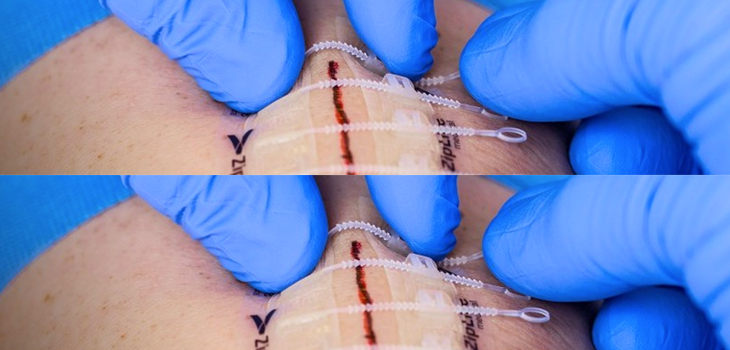
The study, which was unveiled at the recent meeting by Roger Emerson, M.D. of the Texas Center for Joint Replacement in Plano, Texas, provided evidence that Zip Surgical Skin Closure reduced post-discharge costs for total knee arthroplasty (TKA) when compared to staples.
“In the study, we saw that staples and the Zip are both fast to apply in the operating room, but in the post-discharge environment, staple-related issues, such as patient phone calls, emergency department visits, infection concerns and removal create extra work and extra cost in the long run,” said Dr. Emerson in the September 18, 2017 news release. “In addition, patients were apprehensive about staple removal and concerned when they saw redness around their staples, which in some cases triggered antibiotic prescriptions to avoid possible infection.”
As the company wrote in the news release, “The study encompassed 130 consecutive TKA patients, with half of subjects closed with staples and half closed with Zip Surgical Skin Closure. All surgeries were performed at the Texas Center for Joint Replacement by the same surgeon using the same approach and implant, and were closed by the same surgical physician’s assistant. Patients were followed from surgery to first clinic post-operative visit (day 21-28) for assessment.”
“The study findings showed that the Zip reduced all of the following measures when compared to staples: 46% reduction in incision-related actual clinic costs; 60% reduction in incision-related phone calls; 60% reduction in incision-related clinic visits; 75% reduction in incision-related antibiotics prescribed.”
“The Zip is a non-invasive and easy to use skin closure device that replaces sutures, staples, and glue for surgical incisions and lacerations. Clinical studies have demonstrated significant time savings, fewer wound complications and the ability to reduce post discharge healthcare costs. A patented force distribution design results in secure wound closure, excellent scar quality and high patient satisfaction. Unlike staples or sutures, there are no skin punctures with the Zip that can create pathways for bacteria. Benefits of the Zip have been demonstrated in clinical studies in orthopedic total joint arthroplasty, foot and ankle, pediatric cardiothoracic, electrophysiology, dermatology, and plastic and reconstructive surgery.”
Dr. Emerson told OTW, “Any change in the standard of care requires some education and setting of expectations. This included educating and coordinating with Home Health Services on how to remove and handle the new closure device.”
“It is a new approach to surgical closures. It is fairly quick compared to staples, Dermabond, and sutures, but most important is the patient satisfaction component. Patients are very happy with the Zip closure—they don’t have the anxiety seen with staple removals, and the scar is more cosmetically appealing.”
Author
React:
Discussion
This is a fascinating development. In my practice we've seen similar outcomes with the revised protocol. The key differentiator seems to be patient selection criteria. Has anyone else noticed the correlation with BMI thresholds?
Great point. I'd push back slightly on the conclusion, the sample size in the cited study is too small to draw population-level inferences. That said, the directional signal is compelling and worth a larger RCT.
We implemented a similar approach last year. Early results are promising but we're still gathering 12-month follow-up data. Happy to share our protocol if anyone is interested.
Join the conversation
Orthopedic professionals are discussing this. Sign in and upgrade to read every comment and add your voice.