
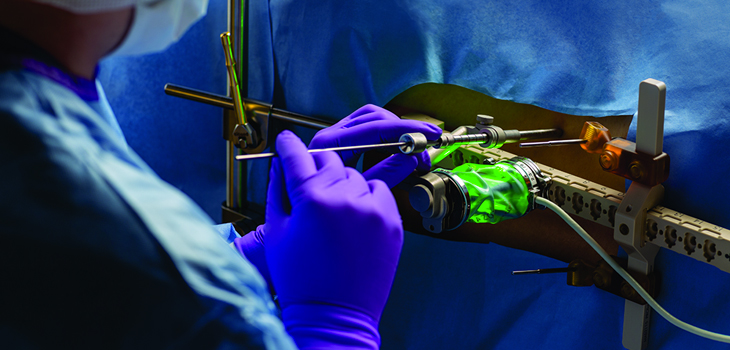
Mazor Robotics has announced the first international PROlat case, performed by Associate Professor Wicharn Yingsakmongkol, M.D. in Bangkok, Thailand.
Mazor: First International PROlat Case
1 min read Premium comments
Secondary
As the company wrote in its September 18, 2017 news release, “PROlat is a single-position solution for placing pedicle screws and other spinal hardware in the lateral decubitus position with the Renaissance Guidance System.”
“Lateral approaches have been gaining acceptance in Asia, as we have an aging population that benefits highly from minimally invasive procedures,” said Professor Yingsakmongkol.
“I perform a high volume of lateral procedures each year, so the PROlat application was something that made a lot of sense to me to enjoy the benefits of the Renaissance technology while the patient remains in a single lateral position. We were able to save 30-40 minutes by not flipping the patient, which is less time for the patient to be under anesthesia, and less cost for the hospital.”
Professor Yingsakmongkol told OTW, “PROlat allows the surgeon to place the percutaneous screws in a single lateral position right after finishing the LLIF (Lateral Lumbar Interbody Fusion) without having to flip the patient so set up is simplified. Moreover, it allows the surgeon to correct complex deformity more precisely by simultaneously re-adjusting or re-positioning the lateral cage with the intraoperative assessment software system (global sagittal and coronal plane profile) prior to wound closure both laterally and posteriorly. This could save surgeons’ intraoperative time, radiation exposure and reduce the total anesthetic time for patients as well.”
“The PROlat technology is very helpful in making the LLIF surgery, which is a two procedure-like surgery (lateral and posterior positions), become a one-procedure surgery (single lateral position) like traditional posterior spine surgery.”
Author
React:
Discussion
This is a fascinating development. In my practice we've seen similar outcomes with the revised protocol. The key differentiator seems to be patient selection criteria. Has anyone else noticed the correlation with BMI thresholds?
Great point. I'd push back slightly on the conclusion, the sample size in the cited study is too small to draw population-level inferences. That said, the directional signal is compelling and worth a larger RCT.
We implemented a similar approach last year. Early results are promising but we're still gathering 12-month follow-up data. Happy to share our protocol if anyone is interested.
Join the conversation
Orthopedic professionals are discussing this. Sign in and upgrade to read every comment and add your voice.