
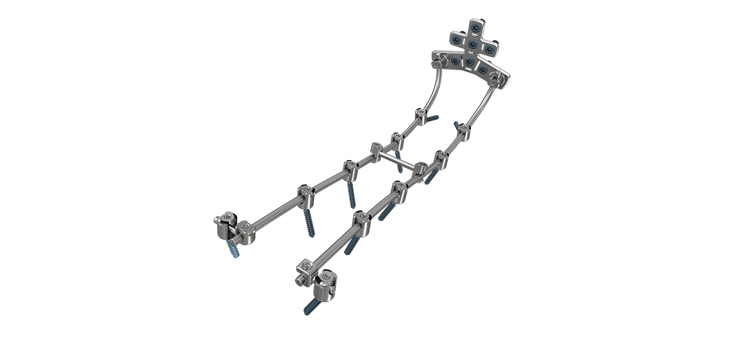
It took the FDA less than three months to clear K2M Group Holdings, Inc.’s Yukon occipito-cervico-thoracic (OCT) fusion system for sale in the U.S. The system is a top-loading, multiple component, posterior OCT spinal fixation system consisting of screws, hooks, rods, rod connectors, and occipital components.
K2M’s OCT Fusion System Cleared in U.S.
2 min read Premium comments
Secondary
The company announced the August clearance on September 29, 2017.
Intended Use
According to FDA documents, the Yukon is intended to provide immobilization and stabilization of spinal segments as an adjunct to fusion for the following acute and chronic instabilities of the craniocervical junction, the cervical spine (C1 to C7) and the thoracic spine (T1-T3).
“Traumatic spinal fractures and/or traumatic dislocations; instability or deformity; failed previous fusions (e.g., pseudoarthrosis); tumors involving the cervical spine; and degenerative disease, including intractable radiculopathy and/or myelopathy, neck and/or arm pain of discogenic origin as confirmed by radiographic studies, and degenerative disease of the facets with instability.”
The system is also intended to restore the integrity of the spinal column even in the absence of fusion for a limited time period in patients with advanced stage tumors involving the cervical spine in whom life expectancy is of insufficient duration to permit achievement of fusion.
In order to achieve additional levels of fixation, the system may be connected to the company’s Everest spinal system components via the rod to rod connectors or transition rods.
New Features
The system, according to the company, features newly designed top-loading, high angulation, polyaxial screws that provide up to 105 degrees of polyaxial angulation. The screw heads accept both Ø3.5 & Ø4.0 mm rods in both cobalt chrome and titanium, and accommodate construct rigidity based on degenerative or deformity corrections. Square thread set screws facilitate screw introduction and minimize the potential for cross-threading, while an updated occipital plate features integrated lateral holes with the goal of enhancing occiput fixation.
Chambliss Harrod, M.D., a spine and orthopedic surgeon at the Bone & Joint Clinic of Baton Rouge, said, unlike systems that feature only highly favored angulation screw designs, the Yukon system, “is a comprehensive system that offers surgeons the ability to treat a variety of spinal conditions—including routine degenerative cases, revisions, and complex cervical deformities.”
The company said the advanced, streamlined reduction instrumentation, “allows for intraoperative flexibility and ease of use. The pistol grip style Rod Reducer provides 20 mm of reduction, while the Sequential Reducers deliver 20 mm of controlled reduction and correction.”
“Balance of the Spine”
Eric Major, the company’s president and CEO said the Yukon system is the company’s new solution “that deepens our expanding portfolio of spinal devices for the occipito-cervico-thoracic region of the spine. Accompanied by our comprehensive Balance ACS platform, [Yukon] offers a competitive surgical solution with the goal of achieving Total Body Balance for patients.”
The company believes achieving “balance of the spine” by addressing each anatomical vertebral segment with a 360-degree approach to the axial, coronal, and sagittal planes, as an important component of surgical success.
To read the FDA clearance document and see the predicate devices used for clearance, click here.
Author
React:
Discussion
This is a fascinating development. In my practice we've seen similar outcomes with the revised protocol. The key differentiator seems to be patient selection criteria. Has anyone else noticed the correlation with BMI thresholds?
Great point. I'd push back slightly on the conclusion, the sample size in the cited study is too small to draw population-level inferences. That said, the directional signal is compelling and worth a larger RCT.
We implemented a similar approach last year. Early results are promising but we're still gathering 12-month follow-up data. Happy to share our protocol if anyone is interested.
Join the conversation
Orthopedic professionals are discussing this. Sign in and upgrade to read every comment and add your voice.