
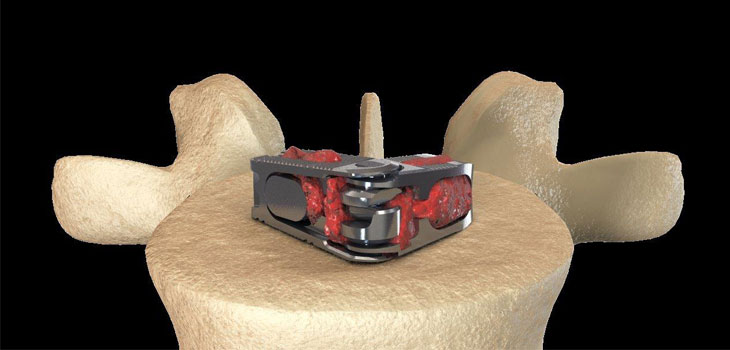
In good news for smaller patients, the FDA has granted 510(k) clearance to Israeli-based Expanding Orthopedics, Inc., to market its interbody FLXfit15 expandable cage.
FDA Clears Expandable Cage For Smaller Patients
1 min read Premium comments
Secondary
The device was cleared on September 15, 2017 after notification was submitted to the FDA in May. The company stated the device will offer surgeon’s more flexibility with different length options for “infinitely adjustable expansion and lordosis correction of up to 4mm and 15°.”
The company’s CEO Ofer Bokobza said, the device will “further enhance the anatomical fit with its 15° lordosis and the shorter footprint version (32mm) will offer great flexibility in treating patients with smaller anatomies.”
While there is a major trend towards minimally invasive procedures in spine, Dale Binke, EOI’s VP of U.S. sales said, “There is an inherent challenge in inserting a large interbody cage that restores lumbar lordosis while controlling sagittal and coronal alignment.”
He said the companies FLXfit has already provided the “ultimate” expandable TLIF solution, combining the “best-in-class footprint that can be delivered through a MIS [minimally invasive surgery] window and a unique expansion mechanism that restores lordosis. With the FLXfit15, EOI’s engineering team has pushed the envelope a step further by combining an articulating cage with optimal footprint which can be easily delivered and expanded in a controlled manner up to 4mm and 15° of lordotic restoration.”
According to the company, the FLXfit is indicated for interbody fusion “in patients with degenerative disc disease (DDD) at one or two contiguous levels from L2 to S1. These DDD patients may also have up to Grade I spondylolisthesis or retrolisthesis at the involved level(s). These patients should be skeletally mature and have completed six months of non-operative treatment.”
The device is intended to be used with supplemental spinal fixation system and with autogenous bone graft. It is important to note, said the company, that the device must be applied in combination with posterior fusion system such as the EOI XPED Pedicle Screw System.
Author
React:
Discussion
This is a fascinating development. In my practice we've seen similar outcomes with the revised protocol. The key differentiator seems to be patient selection criteria. Has anyone else noticed the correlation with BMI thresholds?
Great point. I'd push back slightly on the conclusion, the sample size in the cited study is too small to draw population-level inferences. That said, the directional signal is compelling and worth a larger RCT.
We implemented a similar approach last year. Early results are promising but we're still gathering 12-month follow-up data. Happy to share our protocol if anyone is interested.
Join the conversation
Orthopedic professionals are discussing this. Sign in and upgrade to read every comment and add your voice.