
Heading into the NASS (North American Spine Society) meeting at the end of October, NuVasive, Inc. has announced expanded FDA 510(k) clearances for two of the company’s products.
Expanded Clearances for Limb Lengthening and Interbody Systems
2 min read Premium comments
Secondary
The first, announced on October 12, 2017, was for the PRECICE limb lengthening system. The second, announced four days later, was for the company’s TLX interbody system.
PRECICE System
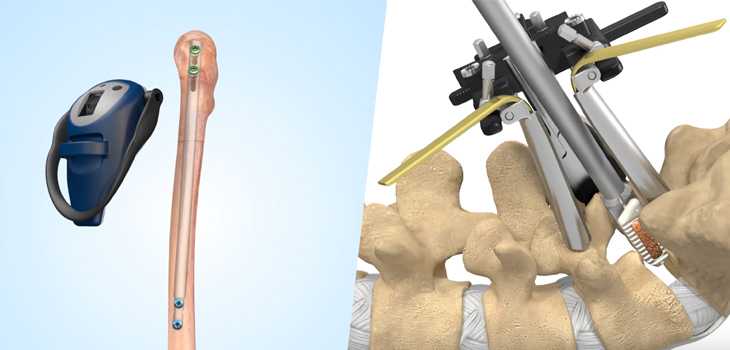
The PRECICE system treats patients with limb length discrepancy, limb deformities and chronic nonunions. The platform consists of an intramedullary device that once implanted utilizes an external remote controller to non-invasively compress and distract long bones.
The company says the key to the platform is the magnetic interaction between the intramedullary nail and external remote control. The technology includes a complex internal gear system remotely activated and controlled by permanent magnets. This allows for a controlled distraction phase with the ability to non-invasively customize treatment.
Before the expanded clearance, the system was only indicated for limb lengthening of the femur and tibia.
The system is now indicated for bone transport of long bones in addition to limb lengthening. Bone transport is a technique that allows for regeneration of bony tissue and is typically used to fill segmental bone loss due to trauma or infection, i.e., infected nonunions, segmental defect, and chronic bone infections.
The TLX Interbody System
The new clearance introduces an expandable 20-degree cage and broader indications for use, including use with allogeneic bone graft and use in additional levels of the spine.
The system is inserted through a conventional transforaminal lumbar interbody fusion (TLIF) approach.
NuVasive developed a minimally invasive approach for the TLIF procedure, the MAS TLIF or Maximum Access Surgery (MAS) TLIF.
Designed to be used with a minimally invasive spine surgery approach, TLX implants, according to the company, can be placed seamlessly into the disc space due to their low profile, bulleted design.
An inserter allows the surgeon to insert, expand and rapidly post pack the implant through the same instrument. The system, says the company, provides restoration of sagittal alignment with customizable degrees of lordosis and was designed to induce lordosis in an anatomical fashion, unique to what is currently on the market.
Before the expanded clearance, TLX interbodies were available in 15-degree lordotic options and were only indicated for use with allograft.
The new indications also include use in the thoracic spine and at the thoracolumbar junction for treatment of disc degeneration disease or degenerative spondylolisthesis at one or two adjacent levels.
Use of the system as an adjunct to fusion in patients diagnosed with multilevel degenerative scoliosis was also cleared.
The company will be in Booth 713 at the NASS meeting held October 25-28, 2017 in Orlando, Florida.
Author
React:
Discussion
This is a fascinating development. In my practice we've seen similar outcomes with the revised protocol. The key differentiator seems to be patient selection criteria. Has anyone else noticed the correlation with BMI thresholds?
Great point. I'd push back slightly on the conclusion, the sample size in the cited study is too small to draw population-level inferences. That said, the directional signal is compelling and worth a larger RCT.
We implemented a similar approach last year. Early results are promising but we're still gathering 12-month follow-up data. Happy to share our protocol if anyone is interested.
Join the conversation
Orthopedic professionals are discussing this. Sign in and upgrade to read every comment and add your voice.