
Why not use bone? A German surgeon asked himself that question and created a new product.
Bone Screws Trump Titanium in German Surgery
1 min read Premium comments
Secondary
For decades surgeons have used metal screws to fasten together two pieces of fractured bone. Then, when the fracture has healed, they have had to go back in and remove the metal screws—which the body perceives and treats as unwanted foreign objects.
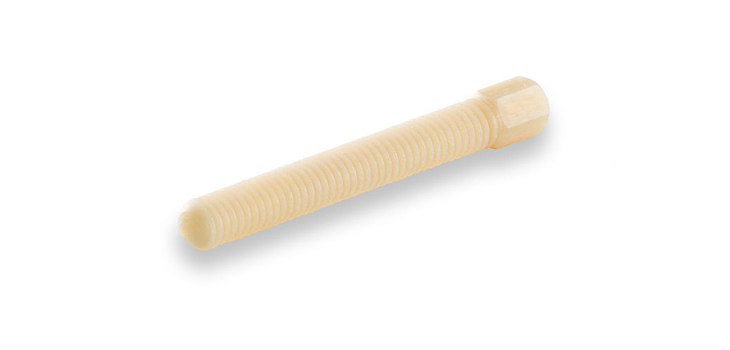
Now orthopedist Klaus Pastl of the TU Graz Knstitute of Biomechanics has created what he calls the “Shark Screw” and claims it as an alternative to metal in general orthopedic and trauma surgery. The Shark Screw is made from the compact and hard middle layer of the human thigh bone—the femur.
The screw does not have to be removed in a second operation after the bones have healed because the donated material will already have been completely absorbed into the patient’s bones. The transplant is so well healed after a year that it does not show up on an X-ray, according to the news release.
The Shark Screw is being produced by the Linz, Austria, start-up surgebright, GmbH, founded in 2016 in cooperation with the German Institute for Tissue and Cell Replacement in Berlin. The patented technology is already being used in 14 Austrian hospitals.
Author
React:
Discussion
This is a fascinating development. In my practice we've seen similar outcomes with the revised protocol. The key differentiator seems to be patient selection criteria. Has anyone else noticed the correlation with BMI thresholds?
Great point. I'd push back slightly on the conclusion, the sample size in the cited study is too small to draw population-level inferences. That said, the directional signal is compelling and worth a larger RCT.
We implemented a similar approach last year. Early results are promising but we're still gathering 12-month follow-up data. Happy to share our protocol if anyone is interested.
Join the conversation
Orthopedic professionals are discussing this. Sign in and upgrade to read every comment and add your voice.