
Astura Medical has been granted clearance from the FDA to market its Bridalveil Occipital-Cervico-Thoracic (OCT) system in the U.S.
Astura Medical’s OCT System Cleared for U.S. Sales
2 min read Premium comments
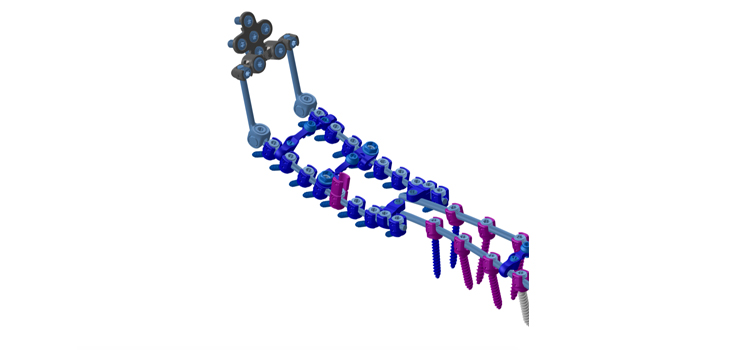
Secondary
According to the company’s 510(k) notification summary, the system is a spinal fixation system “intended to stabilize the uppermost portion of the spine during the fusion process. The system contains a wide variety of implants and instruments which allows for the transition across multiple spinal segments: Occipital Plate with Screws, Cervical Polyaxial Screws, Laminar Hooks, Cross Connectors, Rod Connectors, and Rods manufactured from Ti6Al4V ELI and cobalt chrome alloy.”
In an October 19, 2017 company press release, the company says the plate components of the system contain a multiaxial attachment mechanism to simplify the attachment of rods from the occiput to the thoracic spine.
The system provides a “comprehensive offering of screw options (single-lead, dual-lead, high-top, and smooth shank) ranging from 3.5mm to 5.5mm in diameter that are compatible with either a 3.5mm or 4.0mm rod in titanium or cobalt chrome. The system also provides an extensive line of connectors, transition rods, and instrumentation options to allow surgeons the ability to seamlessly transition across multiple segments of the spine.”
Indications for Use
The system, says the company, is intended to provide immobilization and stabilization of spinal segments as an adjunct to fusion for the following acute and chronic instabilities of the craniocervical junction, the cervical spine (C1 to C7) and the thoracic spine from T1-T3:
- Traumatic spinal fractures and/or traumatic dislocations;
- Instability or deformity;
- Failed previous fusions (e.g., pseudarthrosis);
- Tumors involving the cervical spine; and
- Degenerative disease, including intractable radiculopathy and/or myelopathy, neck and/or arm pain of discogenic origin as confirmed by radiographic studies, and degenerative disease of the facets with instability.
The system is also intended to restore the integrity of the spinal column even in the absence of fusion for a limited time period in patients with advanced stage tumors involving the cervical spine in whom life expectancy is of insufficient duration to permit achievement of fusion.
In order to achieve additional levels of fixation, the company says the system may be connected to the Olympic Posterior Spinal Fixation System rods and connectors. Transition rods with differing diameters may also be used to connect the Bridalveil system to the Olympic system.
This is the eleventh system launched since the Carlsbad, California, company was founded in 2014.
The clearance request was submitted in April 2017 and cleared on October 2, 2017. The primary predicate device named by the company was the Medtronic Vertex Reconstruction System.
The company will be showcasing the system at the 32nd North American Spine Society (NASS) Annual Meeting, taking place in Orlando, October 24-27.
Author
React:
Discussion
This is a fascinating development. In my practice we've seen similar outcomes with the revised protocol. The key differentiator seems to be patient selection criteria. Has anyone else noticed the correlation with BMI thresholds?
Great point. I'd push back slightly on the conclusion, the sample size in the cited study is too small to draw population-level inferences. That said, the directional signal is compelling and worth a larger RCT.
We implemented a similar approach last year. Early results are promising but we're still gathering 12-month follow-up data. Happy to share our protocol if anyone is interested.
Join the conversation
Orthopedic professionals are discussing this. Sign in and upgrade to read every comment and add your voice.