
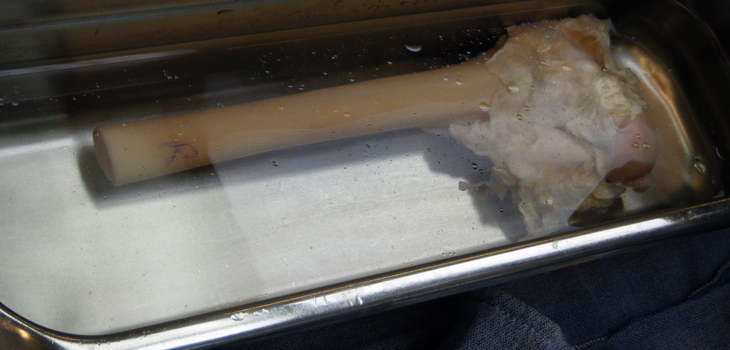
Biologic joint restoration using donor tissue instead of traditional metal and plastic may be an option for active patients with joint defects according to researchers at the University of Missouri (MU) School of Medicine.
Allograft Joint Restoration vs Metal and Plastic
2 min read Premium comments
Secondary
A biologic joint repair typically takes longer to heal than does a traditional replacement. However, if a biologic repair is successful the patient will be able to return to full activity. Unfortunately, not all transplanted bone heals correctly. Researchers at the University of Missouri found that treating donor grafts with bone marrow aspirate concentrate before surgery both speeds recovery and improves bone integration.
“Surgeons performing biologic joint restoration surgeries typically only wash the donor bone to remove the marrow as a pretreatment before implanting the graft,” said James Cook, D.V.M., Ph.D., the William and Kathryn Allen Distinguished Chair in Orthopaedic Surgery at the MU School of Medicine.
“Once implanted, the recipient’s bone has to grow into the donor bone for the surgery to be successful. This graft integration involves a long process called ‘creeping substitution’ that can take more than a year to complete. The first six months are the most critical for success, so we have been studying ways to make this process better and faster.”
Cook’s team compared 17 biologic knee joint grafts implanted without bone marrow concentrate (BMC) to 29 grafts pretreated with BMC. They then compared post-surgical X-ray images at six weeks, three months and six months looking for evidence of graft integration and healing.
The grafts that had been pretreated with BMC achieved 43% bone integration at six weeks, compared to 25% of those that had not been treated. Likewise, at three months, pretreated grafts achieved 67% integration, compared to 50% of the untreated grafts. At six months, the researchers observed that the pretreated grafts were more than 84% fully integrated, compared to 74% of the untreated grafts.
Cook led a pre-clinical study earlier in 2017 that showed BMC provides cells to infiltrate the donor bone and release proteins important to bone healing. “To pretreat a graft with BMC, the patient’s bone marrow is collected at the start of the procedure,” Cook said. “It is processed in the operating room using a centrifuge to make a powerful concentrate containing the patient’s cells and proteins. The resulting BMC is used to saturate the donor bone before it is implanted into the patient’s joint.”
Author
React:
Discussion
This is a fascinating development. In my practice we've seen similar outcomes with the revised protocol. The key differentiator seems to be patient selection criteria. Has anyone else noticed the correlation with BMI thresholds?
Great point. I'd push back slightly on the conclusion, the sample size in the cited study is too small to draw population-level inferences. That said, the directional signal is compelling and worth a larger RCT.
We implemented a similar approach last year. Early results are promising but we're still gathering 12-month follow-up data. Happy to share our protocol if anyone is interested.
Join the conversation
Orthopedic professionals are discussing this. Sign in and upgrade to read every comment and add your voice.