
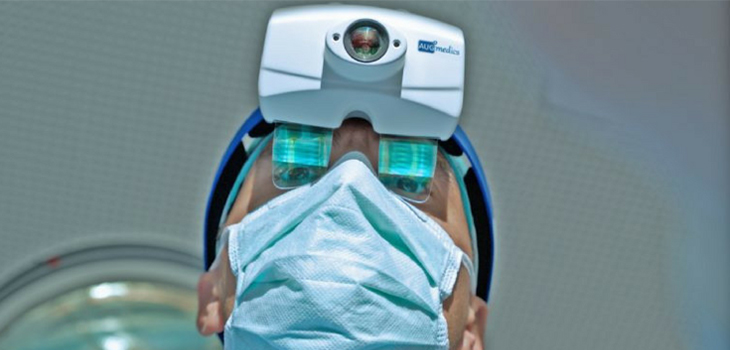
Israel-based Augmedics has announced that it has received $8.3 million in Series A funding to complete its augmented-reality visualization system.
$8.3 MILLION Invested in “See-Through” Surgery
1 min read Premium comments
Secondary
AO Invest, which is fully funded by the non-profit AO Foundation, was the lead investor; as Israeli Innovation Authority, Terra Venture Partners and other undisclosed investors also participated.
As the company wrote in its September 19, 2017 news release, “…With the ViZOR, surgeons can see inside a patient’s anatomy through skin and tissue, for easier, faster and safer surgeries.”
“The ViZOR can be used in many procedures, with the first intended use in minimally invasive spine surgeries. The ViZOR uses proprietary patented see-through AR optics to project a 3D image of a patient’s spine onto a surgeon’s retina, in real-time, with surgical precision and outstanding depth perception.”
“The technology was designed to save time during surgery, reduce radiation exposure and reduce the number of unnecessary repeat operations and hospitalizations…In the future, the ViZOR System will leverage various sensors to collect big surgical data to process and analyze using deep learning algorithms. Ultimately, it will also make suggestions, provide alerts, and perform other surgical assistance during the procedure.”
“The ViZOR System brings disruptive augmented reality technology to spine surgeries to increase safety and enhance surgical performance,” said Nissan Elimelech, company chief executive officer. “Augmedics designed The ViZOR to give surgeons the first-time opportunity to actually see inside a patients’ anatomy, providing valuable real-time information in a comfortable and intuitive manner.”
Elimelech told OTW, “We plan to complete product development and get regulatory clearance for the ViZOR (FDA clearance/CE mark) by early 2019. In addition to that, we have a team of seven top-notch computer vision engineers who will continue our research and development, exploring the integration of cutting-edge technologies such as machine learning and even robotic surgery into the next generation ViZOR.”
Author
React:
Discussion
This is a fascinating development. In my practice we've seen similar outcomes with the revised protocol. The key differentiator seems to be patient selection criteria. Has anyone else noticed the correlation with BMI thresholds?
Great point. I'd push back slightly on the conclusion, the sample size in the cited study is too small to draw population-level inferences. That said, the directional signal is compelling and worth a larger RCT.
We implemented a similar approach last year. Early results are promising but we're still gathering 12-month follow-up data. Happy to share our protocol if anyone is interested.
Join the conversation
Orthopedic professionals are discussing this. Sign in and upgrade to read every comment and add your voice.