
Medtronic plc has received Supplemental PMA (premarket application) Approval from the FDA for the world’s smallest implantable spinal cord stimulator.
World’s Smallest Spine Stim Device Approved by FDA
3 min read Premium comments
Secondary
The announcement of the approval came on September 18, 2017. The company then also announced the U.S. launch of the Intellis platform for the management of certain types of “chronic intractable pain.” The platform includes the stimulator.
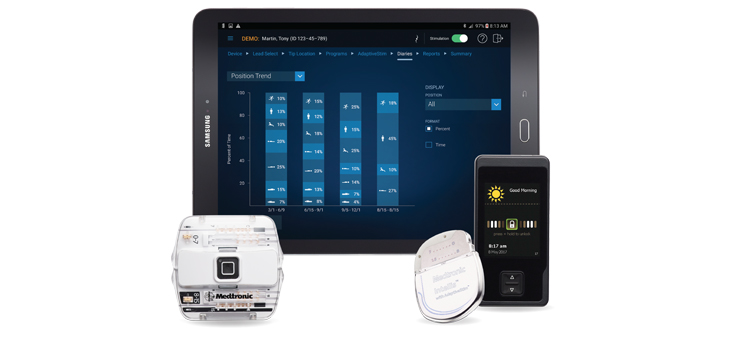
The platform, according to the company, was designed to overcome limitations with current spinal cord stimulation (SCS) systems, such as battery performance. The platform can also power the EvolveSM workflow, which standardizes guidance and balances high-dose (HD) and low-dose (LD) therapy settings.
Patient activity can be recorded 24 hours a day. The platform is managed on the Samsung Galaxy Tax S2 tablet interface. This, says the company, allows physicians to address the “subjective and personal nature” of chronic pain by monitoring progress and making modifications.
One of the first patients was implanted with the device at Duke University Medical Center in Durham, North Carolina.
“Chronic pain is challenging to manage. Having real-time data can provide more information about patients’ quality of life changes,” said Lance Roy, M.D., pain medicine specialist at the Center. “This platform represents a welcome new option for managing some kinds of chronic pain. New non-opioid treatment options are important given the national crisis related to opioid abuse.”
The company cites data estimating that 30% of the 300,000 patients annually that undergo lumbosacral spine procedures develop chronic intractable pain. Neurostimulation, added the company announcement, has been proven to provide effective long-term pain relief and improve quality of life, in addition to being a treatment option for patients interested in trying a non-drug alternative.
“This isn’t just about a new device,” said Marshall Stanton, M.D., senior vice president and president of Medtronic’s Pain Therapies division, “but about combining cutting edge hardware with optimal therapy through the Evolve workflow to enable personalized, long-term pain relief.”
The platform tracks and shares daily activities, body positions and therapy usage and gives physicians an objective look at mobility and progress. The company says the platform also addresses a common patient complaint: battery recharge issues. “With Medtronic’s proprietary Overdrive battery technology, the Intellis battery can be fully recharged from empty to full in approximately one hour and physicians can now estimate recharge intervals based on therapy settings.”
The supplemental approval includes additional advances in the platform, such as secure wireless Samsung Galaxy Tab S2 programmers for physicians that enable faster delivery of evolving workflows and software upgrades.
And there’s more. The platform also includes both Medtronic’s proprietary SureScan MRI technology for the “broadest access available to MRI diagnostic imaging and simple eligibility determination, which allows MRI scans anywhere on the body under certain conditions, as well as AdaptiveStim technology for automatic adjustments to deliver the right therapy dose to the right location, as the pain target shifts based on body position.”
The device is implanted under a patient’s skin to deliver mild electrical impulses through a lead implanted in the epidural space to block pain signals from going to the brain. SCS is a non-opioid therapy that, according to the company, “is clinically proven and cost-effective for treating chronic pain. Multiple randomized controlled trials have demonstrated that SCS provides more effective pain relief than both re-operation and conventional medical management.”
The supplemental PMA application was submitted to the FDA at the end of October 2016 with approval granted in less than nine months. Original PMA approval was granted in November 1984. According to FDA records, there have been many supplemental approvals for this device, as well as some recalls that were all resolved.
Author
React:
Discussion
This is a fascinating development. In my practice we've seen similar outcomes with the revised protocol. The key differentiator seems to be patient selection criteria. Has anyone else noticed the correlation with BMI thresholds?
Great point. I'd push back slightly on the conclusion, the sample size in the cited study is too small to draw population-level inferences. That said, the directional signal is compelling and worth a larger RCT.
We implemented a similar approach last year. Early results are promising but we're still gathering 12-month follow-up data. Happy to share our protocol if anyone is interested.
Join the conversation
Orthopedic professionals are discussing this. Sign in and upgrade to read every comment and add your voice.