
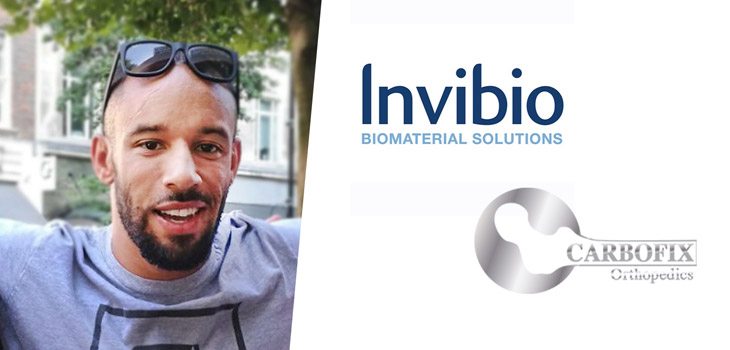
United Kingdom’s Olympic Sprinter James Ellington recently teamed up with Invibio Biomaterial Solutions and CarboFix Orthopedics to share how a new fracture treatment has the potential to offer a quicker recovery for patients.
UK Olympian Teams Up With Invibio and CarboFix Orthopedics
2 min read Premium comments
Secondary
This is a cause close to his heart after a motorcycle accident in Tenerife earlier this year put his athletic ambitions on hold. During a severe head-on collision with a car while on his bike, Ellington’s legs and pelvis were completely smashed.
“My biggest fear was that I would never run again,” he told OTW. “But luckily the surgeon was very conscious of what I do for a living and suggested a CarboFix nail in treating the severe tibia fracture.”
According to Ellington, the CarboFix nail is lighter weight and has a faster healing potential, compared to metal. The rod is made from a new composite polymer from Invibio Biomaterial Solutions, a global leader of PEEK OPTIMA polymer solutions for medical device companies headquartered in the United Kingdom.
“Recovery has been going great. This week I was able to jog on the treadmill and it is going really well. I am hopeful that I will be able to get back on the track.”
John Devine, medical business unit director for Invibio Biomaterial Solutions told OTW that the carbon fiber material from Invibio has a lot of advantages.
“It offers better fatigue resistance than metals for patients who have trouble with healing. Having something that has the potential to last longer can be an advantage but what was really interesting in terms of James and his physician is they wanted it to really accelerate healing.”
“The benefits we hope that it brings is that the implant is less stiff, but at the same time strong enough to treat fracture, and accelerate the healing process.”
According to Matt Cantwell trauma business leader for Invibio Solutions, all people could benefit from the quicker return to function but patients at high risk for a nonunion could be especially good candidates for CarboFix nails or plates. These include patients who have challenges with healing like people suffering from diabetes, obesity or people who have osteoporosis or poor bone quality due to obesity, smoking, and alcohol. High energy fractures like the one that James suffered in his accident also fit into this category.
CarboFix Orthopedics, which is focused on developing orthopedic solutions and is headquartered in Israel, is hoping to help James and other patients with similar injuries recover faster by using trauma implants made from Invibio’s PEEK-OPTIMA Ultra-Reinforced.
Ron Szekely, CarboFix Orthopedics’ vice president of sales and marketing said in a release, “The aim itself to get back on track is fantastic, whether that’s the athletic track or returning to other individual recovery goals. This can be an important driver for rehabilitation.”
“In addition to dedication and enthusiasm, patients need to have access to innovative medical devices that can support this. At CarboFix, we believe in the potential of changing trauma treatments to improve the quality of life for many patients.”
Ellington has already made great progress since his accident and is focused on becoming an active athlete again.
Author
React:
Discussion
This is a fascinating development. In my practice we've seen similar outcomes with the revised protocol. The key differentiator seems to be patient selection criteria. Has anyone else noticed the correlation with BMI thresholds?
Great point. I'd push back slightly on the conclusion, the sample size in the cited study is too small to draw population-level inferences. That said, the directional signal is compelling and worth a larger RCT.
We implemented a similar approach last year. Early results are promising but we're still gathering 12-month follow-up data. Happy to share our protocol if anyone is interested.
Join the conversation
Orthopedic professionals are discussing this. Sign in and upgrade to read every comment and add your voice.