
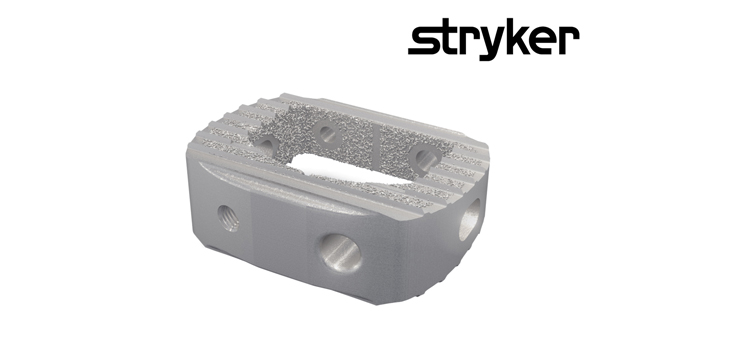
The FDA has cleared Stryker Spine division’s 3D-printed Tritanium C Anterior Cervical Cage for the marketplace.
Stryker’s 3D-Printed Cage Cleared for Market
2 min read Premium comments
Secondary
A September 20, 2017 company statement said the device is made using Stryker’s proprietary Tritanium In-Growth Technology. The technology involves a highly porous titanium material designed for bone in-growth and biological fixation. The company says Tritanium material may be able to wick or retain fluid, in contrast to traditional titanium material.
An in vitro study cited by the company said, “the unique porous structure of the Tritanium material is designed to create a favorable environment for cell attachment and proliferation. It is inspired by the microstructure of cancellous bone and enabled by AMagine, Stryker’s proprietary approach to implant creation using additive manufacturing.”
Additive Manufacturing
Bradley Paddock, president of Stryker’s Spine division, said the benefits of additive manufacturing to create highly porous spinal implants “that are ‘engineered for bone’ are becoming increasingly clear. Additive manufacturing allows us to push beyond conventional manufacturing techniques to address design complexity and achieve previously unmanufacturable geometries, while delivering the performance, reproducibility, and quality our customers have come to expect.”
The Cage
The company said the cage features an open central graft window and lateral windows to help reduce stiffness of the cage and minimize subsidence and allow for bone graft containment.
“Engineered for stability, the cage has serrations on the superior and inferior surfaces designed for bidirectional fixation and to maximize surface area for endplate contact with the cage. Its smooth posterior edges help to facilitate insertion and protect soft tissue and anatomy.”
The cage is available in a number of footprints, heights, and lordotic angles to adapt to a variety of patient anatomies. It will be available to surgeons in the fourth quarter of 2017.
Intended Use
The Intended Use statement by the company states the following:
“The Tritanium C Anterior Cervical Cage is indicated for use in cervical interbody fusion procedures in skeletally mature patients with degenerative disc disease (DDD) at one level or two contiguous levels from the C2 to T1 disc. The cage is to be used with autogenous and/or allogenic bone graft comprised of cancellous and/or corticocancellous bone graft, and is to be implanted via an open, anterior approach.”
Author
React:
Discussion
This is a fascinating development. In my practice we've seen similar outcomes with the revised protocol. The key differentiator seems to be patient selection criteria. Has anyone else noticed the correlation with BMI thresholds?
Great point. I'd push back slightly on the conclusion, the sample size in the cited study is too small to draw population-level inferences. That said, the directional signal is compelling and worth a larger RCT.
We implemented a similar approach last year. Early results are promising but we're still gathering 12-month follow-up data. Happy to share our protocol if anyone is interested.
Join the conversation
Orthopedic professionals are discussing this. Sign in and upgrade to read every comment and add your voice.