
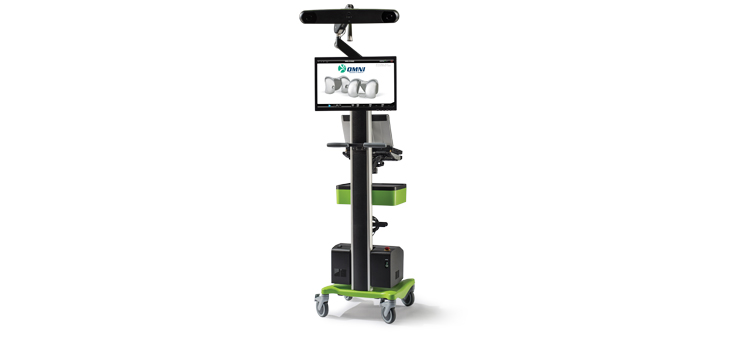
“Breakthrough technology” and performing a “perfect total knee replacement” is how OMNIlife science, Inc. described its Active Spacer robotic tissue balancing device just cleared by the FDA.
OMNIlife Touts “Perfect” TKR Device Clearance
1 min read Premium comments
Secondary
In a September 6, 2017 announcement, the company said the new technology, in clinical use since March in Australia, “provides the surgeon with a quantitative tool to actively manage the soft tissue envelope with dynamic real-time feedback. When combined with the accuracy of alignment and bone cuts provided by the OMNIBotics system, the result is a completely customized procedure from both a skeletal perspective as well as a soft tissue perspective.”
“This is a major milestone for both OMNI and for the orthopedic market,” stated Vice President of Robotics Christian Joly. “We are now the only company in the world to provide a robotic technology to quantitatively drive the total knee replacement (TKR) surgical procedure with both alignment and ligament balancing.”
The OMNIBotics system, says the company, “enables optimized knee implant placement using robotics driven by OMNI’s proprietary ART software. With more than 16,000 OMNIBotics procedures performed to date worldwide, it eliminates the need for preoperative CT scans or x-rays. Intraoperative adjustments are easily made, and the precise alignment of the implant may lead to a more rapid recovery and a more natural feeling total knee replacement.”
“We have been convinced that a perfect knee alignment is not enough to enable good outcomes for our surgeons and their patients,” said Guy Mayer, Executive Chairman of OMNI’s Board of Directors. “We believe that our surgeons can now perform the perfect total knee replacement with our innovative robotic soft tissue balancing technology coupled with the optimum knee alignment provided by our OMNIBotics technology.”
To watch a company video of the system in action, click here.
OMNIlife science is privately held and located in Raynham, Massachusetts.
Author
React:
Discussion
This is a fascinating development. In my practice we've seen similar outcomes with the revised protocol. The key differentiator seems to be patient selection criteria. Has anyone else noticed the correlation with BMI thresholds?
Great point. I'd push back slightly on the conclusion, the sample size in the cited study is too small to draw population-level inferences. That said, the directional signal is compelling and worth a larger RCT.
We implemented a similar approach last year. Early results are promising but we're still gathering 12-month follow-up data. Happy to share our protocol if anyone is interested.
Join the conversation
Orthopedic professionals are discussing this. Sign in and upgrade to read every comment and add your voice.