
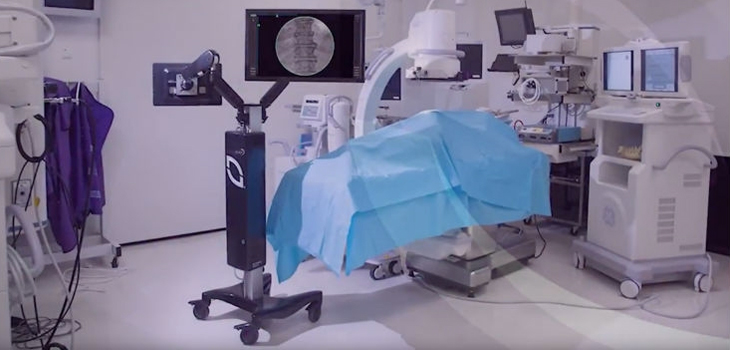
NuVasive, Inc. is trying to bring down the level of radiation exposure in the operating room (OR), and has just announced the commercial launch of its LessRay software technology system.
NuVasive Launches LessRay Technology
2 min read Premium comments
Secondary
“The launch of LessRay (Winner of OTW’s Best Technology in Spine 2015) is a significant milestone for NuVasive, as we begin to sell capital equipment and bring technology advancements into the hospital O.R.,” said Gregory T. Lucier, chairman and chief executive officer of NuVasive, in the company’s September 13, 2017 news release.
“With LessRay’s ability to dramatically reduce radiation exposure, as well as its enhanced imaging capability, we are now executing on our imaging and navigation strategy to improve spine surgery productivity and ultimately predictability. Given the healthy pipeline of interest from customers already, the strong demand demonstrates a critical need for a solution like LessRay to address a major safety issue related to radiation facing surgeons and hospital administrators.”
Gregory Lucier told OTW, “Surgeon interest has been strong since we first announced LessRay in 2016. This demand demonstrates a critical need for a solution that addresses OR safety and LessRay solves the safety issue related to radiation facing surgeons and hospital administrators.”
According to NuVasive’s news release, “Studies show spine and orthopedic surgeons can receive their lifetime occupational radiation limit within the first 10 years of their career.”
“As a result, cancer rates and contraction of cataracts associated with radiation exposure are nearly double that of other surgery practices. LessRay’s proprietary image enhancement technology improves low-dose, low-radiation fluoroscopy (or x-ray) images to have similar diagnostic capabilities as conventional full-dose fluoroscopy images, thereby reducing radiation emission and exposure in the O.R while retaining the high resolution of a full radiation dose shot.”
“Additionally, LessRay has other features to help reduce the number of fluoroscopic shots needed, thus decreasing the overall radiation even further.”
“Results of a recent prospective study conducted with patients randomized to which surgical intervals were performed with standard-dose fluoroscopy or fluoroscopy using LessRay, which measurement of radiation emission and exposure showed that radiation exposure of healthcare professionals in the O.R. was between 62% and 84% lower in the LessRay group compared to the conventional fluoroscopy group.”
“Additional LessRay system benefits for spine surgeons and staff that help increase O.R. efficiency include:
- C-arm tracking: Simplifies localization and target anatomy quickly, accurately and without the unnecessary fluoroscopy time and scouting images.
- Image stitching: Minimizes surgical workflow interruption by quickly stitching together fluoroscopic images of any spine segment.
- Angle finder: Minimizes O.R. steps required to obtain crisp endplate shots with fewer fluoroscopic images than traditional C-arm scouting.
- Alternate view: Improves visualization by making metal instruments invisible or semi-transparent by fading out their obstruction.”
Gregory Lucier commented to OTW, “We continually remind our surgeons that studies show spine and orthopedic surgeons can receive their lifetime occupational radiation limit within the first 10 years of their career.”
Author
React:
Discussion
This is a fascinating development. In my practice we've seen similar outcomes with the revised protocol. The key differentiator seems to be patient selection criteria. Has anyone else noticed the correlation with BMI thresholds?
Great point. I'd push back slightly on the conclusion, the sample size in the cited study is too small to draw population-level inferences. That said, the directional signal is compelling and worth a larger RCT.
We implemented a similar approach last year. Early results are promising but we're still gathering 12-month follow-up data. Happy to share our protocol if anyone is interested.
Join the conversation
Orthopedic professionals are discussing this. Sign in and upgrade to read every comment and add your voice.