
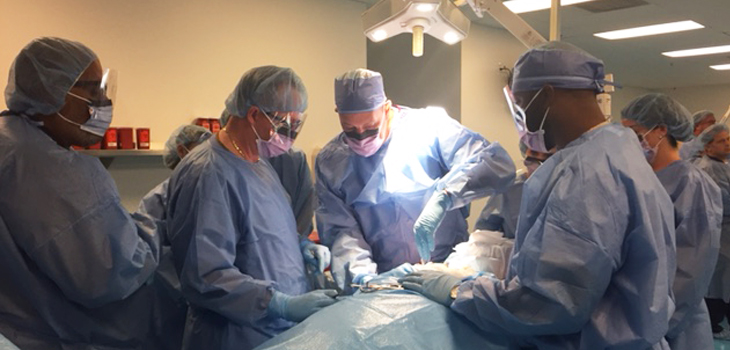
Medacta International, based in Castel San Pietro, Switzerland, is known for its training and support of surgeons. Now, the company and the Medacta Orthopaedic Research and Education (M.O.R.E.) Institute have announced the 250the M.O.R.E. AMIS (Anterior Minimally Invasive Surgery Learning Center). The event, to be held September 15-16, 2017 in Chicago, Illinois, will be followed by a European event on September 25-26, 2017 in Basel, Switzerland.
Medacta: 250th AMIS Learning Center on Anterior Hip Approach
2 min read Premium comments
Secondary
As the company wrote in its September 6, 2017 news release, “…surgeons from all over the world will come to learn Medacta’s Anterior Minimally Invasive Surgery (AMIS) technique, complete with a system of tools and educational resources designed to support surgeons practicing the anterior approach for hip replacement.”
“The promotion of patient well-being through AMIS is a cornerstone of Medacta’s mission, as it exemplifies our belief that only with a strong focus on medical education can surgical innovation truly move the industry forward,” said Francesco Siccardi, executive vice president of Medacta International. “The patient-centric technique is also ideal for the outpatient or same-day surgery setting, providing more options for both surgeons and patients in today’s changing healthcare landscape.”
“The AMIS technique, informed by decades of clinical experience, is a muscle-sparing approach to total hip replacement that is associated with potential positive patient outcomes like shorter hospitalization and rehabilitation time, as well as a faster return to daily activities,” says the news release.
“Offered as part of the M.O.R.E. Institute, the M.O.R.E. AMIS Education Program is a comprehensive offering for surgeons seeking to become proficient in the technique, including ongoing medical education and dedicated implants and instruments. To date, more than 5,500 surgeons across 31 countries have received training through the program. At the end of 2016, that translated to more than 80,000 hours of proctoring and surgeon-to-surgeon mentoring. In the field, surgeons have performed more than 250,000 total hip replacements utilizing the AMIS platform so far.”
Asked about the most important things for trainees to master, Matt Delong, vice president of Hips and Shoulders at Medacta, told OTW, “The anterior approach to hip replacement is a demanding technique to learn. With that, the key benefits of attending our courses and enrolling in our AMIS curriculum, which goes well beyond one training course, is receipt of a very detailed review of managing the anatomy of the anterior hip, learning the intermuscular and internervous path to the joint, and perhaps most important, learning the proper use of the AIMS hip instruments and leg positioner specially designed to facilitate the procedure.”
“The anterior approach is a complex procedure and thus has a complex learning curve, so abandoning the procedure was commonplace in years past. With our curriculum, surgeons will have an experienced AMIS user present for their first procedures, literally proctoring their first cases. This allows dedicated one-on-one mentorship of real-time surgery which subsequently fosters confidence in the trainee’s mind regarding the procedure. Even after the initial training and proctoring, Medacta will continue to support surgeons utilizing the AMIS technique with advanced education opportunities, including round table discussions, revision training, and even further.”
Author
React:
Discussion
This is a fascinating development. In my practice we've seen similar outcomes with the revised protocol. The key differentiator seems to be patient selection criteria. Has anyone else noticed the correlation with BMI thresholds?
Great point. I'd push back slightly on the conclusion, the sample size in the cited study is too small to draw population-level inferences. That said, the directional signal is compelling and worth a larger RCT.
We implemented a similar approach last year. Early results are promising but we're still gathering 12-month follow-up data. Happy to share our protocol if anyone is interested.
Join the conversation
Orthopedic professionals are discussing this. Sign in and upgrade to read every comment and add your voice.