
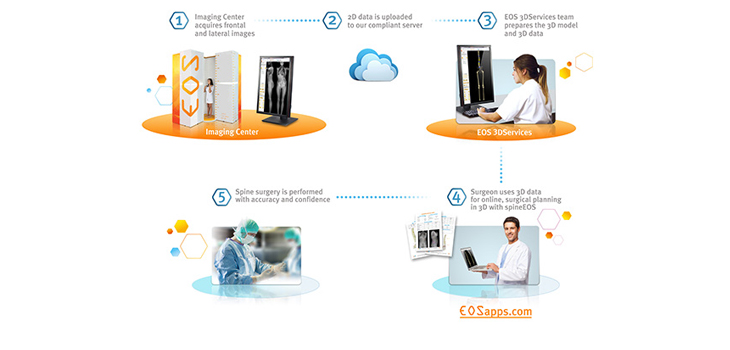
EOS imaging, headquartered in Paris, France, is set to introduce a new version of spineEOS, the company’s online 3D planning software for spine surgery.
EOS Personalized Biomechanical Simulation Spine Surgery Planning
1 min read Premium comments
Secondary
As the company wrote in its September 5, 2017 news release, “spineEOS is the first software to incorporate biomechanical patient data into treatment simulation and planning to help physicians optimize the patient’s spinal treatment. It has received CE Mark approval in Europe and has been submitted to the U.S. Food and Drug Administration (FDA) for approval.”
Marie Meynadier, Ph.D., chief executive officer of EOS imaging, said, “Spine flexibility, which varies from patient to patient, is a key component of how a patient will react to spinal surgery. We are very excited to introduce, for the first time, biomechanical algorithms that take into account the specific flexibility of the patient spine, further improving the spineEOS treatment simulation and planning to accurately reflect the patient’s post-surgical reaction.”
“We believe this will be particularly beneficial for patients with complex spinal disorders, where proper pre-operative simulation can help surgeons choose the right surgical strategy, optimize the shape and position of the implant across different spinal levels, and positively impact the final alignment and long-term outcomes.”
Dr. Meynadier told OTW, “The new software was developed by combining our internal 3D modeling and anatomic tagging algorithms with the biomechanical simulation technologies of our exclusive partner Spinologics in Montreal.”
EOS imaging introduced the new spineEOS software in a symposium during the recent Scoliosis Research Society (SRS) 52nd Annual Meeting & Course.
The symposium included presentations from the first physicians to utilize the new spineEOS software. The physicians presenting in the symposium include: Dr. Lawrence Lenke, New York Presbyterian/Columbia University Medical Center, New York; Dr. Salil Upasani, Rady Children’s Hospital, San Diego; Dr. Stefan Parent, Sainte Justine, Montréal; Dr. Brice Ilharreborde, Robert Debré Hospital, APHP, Paris.
Author
React:
Discussion
This is a fascinating development. In my practice we've seen similar outcomes with the revised protocol. The key differentiator seems to be patient selection criteria. Has anyone else noticed the correlation with BMI thresholds?
Great point. I'd push back slightly on the conclusion, the sample size in the cited study is too small to draw population-level inferences. That said, the directional signal is compelling and worth a larger RCT.
We implemented a similar approach last year. Early results are promising but we're still gathering 12-month follow-up data. Happy to share our protocol if anyone is interested.
Join the conversation
Orthopedic professionals are discussing this. Sign in and upgrade to read every comment and add your voice.