
Invibio Biomaterial Solutions, based in Thornton Cleveleys, UK, was pleased to see the latest strong showing of PEEK (polyetheretherketone) at the recent International PEEK Meeting in Washington, D.C.
Carbon Reinforced PEEK for Trauma, Potentially Disruptive?
2 min read Premium comments
Secondary
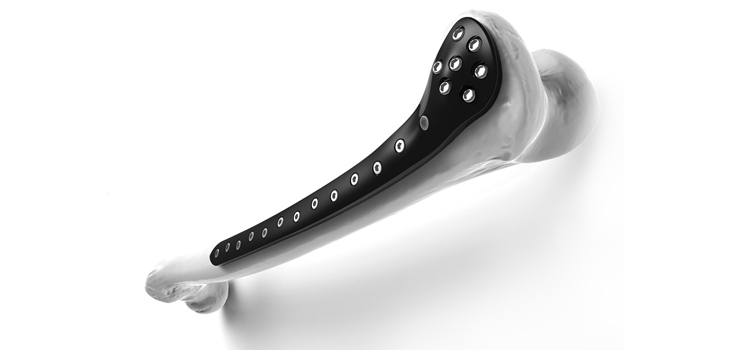
According to the company’s August 29, 2017 news release, the meeting, “…highlighted the increasing adoption of PEEK implants in clinical practice as well as the material’s established position due to possible patient benefits. In particular, the potential of carbon fiber-reinforced PEEK (CFR-PEEK) plates for fracture fixation became increasingly compelling; moreover, additive manufacturing was revealed as making progress in the production of PEEK polymer-based implants.”
“A wealth of research and clinical experience is confirming that PEEK polymer-based implants have an established position due to potential patient benefits and, what is more, they still offer immense development possibilities,” commented Steve Kurtz, Ph.D., Implant Research Center, Drexel University in Philadelphia, Pennsylvania, and conference organizer. “While additive manufacturing in medical is in its infancy, we think it could revolutionize the ease, speed and accuracy with which implants are manufactured.”
As the company noted in its news release, “Additive manufacturing can deliver patient customized implants (PCI) and enables direct linkage to digital patient models that may change the face of pre-operative planning and surgery. 3D printing specialist Apium Additive Technologies GmbH, for example, is offering a commercially available 3D printer that is capable of processing PEEK. The model P155 uses Apium’s innovative patent-pending Fused Filament Fabrication (FFF) 3D printing technology.”
Asked about the most promising aspect of PEEK polymer-based implants, Dr. Kurtz told OTW, “In the near term, I would say that carbon fiber reinforced implants for trauma fracture patients have the potential to be really disruptive. These implants have demonstrated outstanding fatigue strength and promising early clinical results in challenging patients. Longer term, the technologies being developed for additive manufacturing (also known as 3D printing) of PEEK implants have the potential to streamline the creation of patient-specific PEEK devices. It is still too early to predict when 3D printed PEEK implants will be widely used, but the technology has disruptive potential across many different implant therapeutic areas.”
“Material technologies continue to improve so I’d like surgeons to keep an open mind about adopting new technology. These implants can offer improved fatigue strength, greater callus formation and better imaging which contributes to better outcomes. Take advantage of the upcoming OTA [Orthopaedic Trauma Association] meeting in Vancouver to learn more.”
Author
React:
Discussion
This is a fascinating development. In my practice we've seen similar outcomes with the revised protocol. The key differentiator seems to be patient selection criteria. Has anyone else noticed the correlation with BMI thresholds?
Great point. I'd push back slightly on the conclusion, the sample size in the cited study is too small to draw population-level inferences. That said, the directional signal is compelling and worth a larger RCT.
We implemented a similar approach last year. Early results are promising but we're still gathering 12-month follow-up data. Happy to share our protocol if anyone is interested.
Join the conversation
Orthopedic professionals are discussing this. Sign in and upgrade to read every comment and add your voice.