
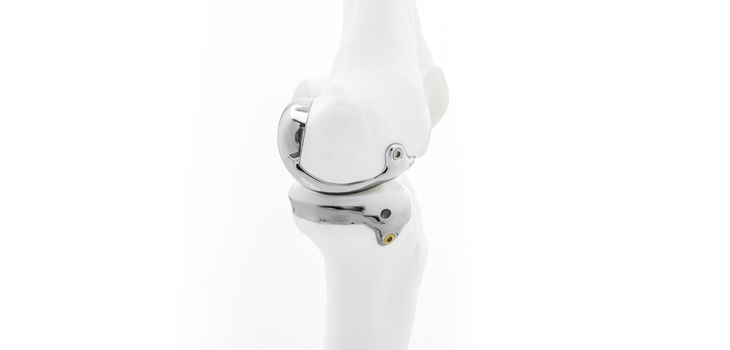
Quebec City-based Bodycad has announced that the first personalized restoration procedures using its Unicompartmental Knee System in patients have been successfully performed.
Bodycad: First Personalized Uni Knee Restoration
2 min read Premium comments
Secondary
“The personalized restoration enabled me to perform the procedure in an exact manner with minimal bone resection,” said Brian Hamlin, M.D., co-director of the Bone and Joint Center of Magee-Womens Hospital of University of Pittsburgh Medical Center, one of two orthopedic surgeons to perform the procedure, in the September 14, 2017 news release. “The reconstruction resulted in a well-balanced knee with optimized tracking while avoiding overcorrection.”
As the company wrote in its news release, “Bodycad uses proprietary imaging algorithms to produce a precise 3D image of the patient’s knee. Its suite of Personalized Restoration Software enables a seamless integration of the image to implant process called the PREP (personalized restoration evaluation process). The efficient, rapid, and highly automated process is the only one of its kind in the world that is impeccably integrated between software and modern manufacturing such as 3D printing.”
“I was involved throughout the production of the personalized restoration,” said Professor Werner Siebert of Vitos Orthopedic Clinic Kassel and incoming president of the German Orthopaedic Society, who also performed the procedure. “I provided patient imaging, consulted with a Bodycad PREP Tech on the resulting rendering, and then reviewed and approved the final design. The result was an exceptional fit for the patient.”
“Everyone’s anatomy is unique and that’s why standardized implants have limitations,” says Jean Robichaud, president and founder of Bodycad. “These recent procedures reinforce a growing body of evidence that demonstrates the benefit of personalized restorations.”
Robichaud told OTW, “The simplicity and precision of the personalized tools and implants themselves were mentioned throughout the surgeries. Also noted by the support staff was the reality that only one instrument tray is needed for the entire procedure. In Pittsburg, even the surgical box with its professional aspects were a craze. I am very excited that the recent surgeries were a complete success. It is still too early for official post-op commentaries but everything is going very well. One thing’s for such though, the industry knows its future lies in personalized treatments and Bodycad is already a technological leader in this paradigm-changing era and will rapidly become a worldwide reference.”
“We just initiated clinical cases in Europe and the U.S. The initial feedback has been positive and the data is encouraging. The participating surgeons are monitoring the patients and providing Bodycad feedback as they continue to follow their patients.”
“The greatest learning has been validation of our approach to personalized restorations. The surgeons that have been performing these cases have reported that with Bodycad the surgical technique has been dramatically simplified because they can start the case with cutting the tibial bone, without the need for calibrating the cut and the final implant determination. This contributes to placing a personalized restoration that is designed to each patient’s unique anatomy.”
Author
React:
Discussion
This is a fascinating development. In my practice we've seen similar outcomes with the revised protocol. The key differentiator seems to be patient selection criteria. Has anyone else noticed the correlation with BMI thresholds?
Great point. I'd push back slightly on the conclusion, the sample size in the cited study is too small to draw population-level inferences. That said, the directional signal is compelling and worth a larger RCT.
We implemented a similar approach last year. Early results are promising but we're still gathering 12-month follow-up data. Happy to share our protocol if anyone is interested.
Join the conversation
Orthopedic professionals are discussing this. Sign in and upgrade to read every comment and add your voice.