
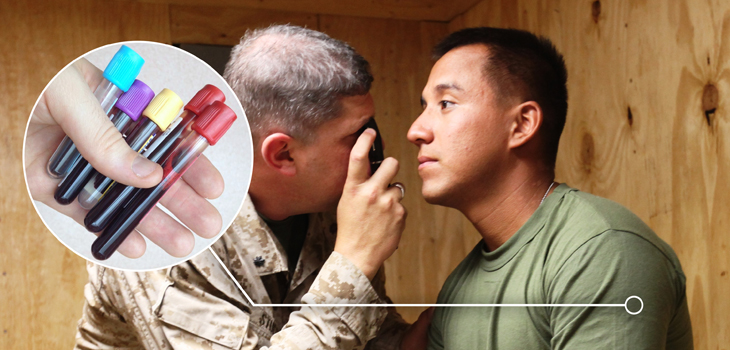
A new study, “Assessing the accuracy of blood RNA profiles to identify patients with post-concussion syndrome: A pilot study in a military patient population” published in the September, 2017 issue of PLOS One suggests that blood testing may be possible to diagnose long-term concussions.
Blood Test May Improve Concussion Diagnosis
1 min read Premium comments
Secondary
According to a press release, researchers from the Morehouse School of Medicine’s Neuroscience Institute and Department of Medicine in Atlanta, Georgia, found that blood RNA profiles were more accurate at diagnosing serious brain injuries in a military patient population which in turn leads to better treatment.
“The way they currently diagnose concussions is that they have to do a neuropsychological assessment, which are these psychological tests to determine whether you have memory problems, whether you have sleep problems. It’s not very exact science. It’s quite subjective,” said lead researcher Robert Meller, D. Phil and associate professor at Morehouse School of Medicine in a release.
“Patients can over-exaggerate or under-report symptoms. It’s very difficult to get a clear picture of what’s going on with a patient.”
During a concussion, there is damage to the blood-brain barrier and normal waste clearance via the lymphatic system which can be detected in the blood. During this pilot study, the researchers evaluated the accuracy of whole transcriptome analysis of blood in 60 patients with clinically diagnosed chronic concussion and controls in a military cohort.
According to the data, the accuracy of RNA profiles to predict the clinical diagnosis of post-concussion syndrome patients from controls was 86% (sensitivity 80%; specificity 89%). In addition, RNA profiles reveal duration of concussion.
Meller explained that with this type of testing there won’t be the same issues you have with self-reporting.
“If you’re a sports player, you don’t want to admit you’ve been hurt because you’ll lose your position on the team, which could have a great impact on your future,” Meller said. “They typically underplay their symptoms.”
He said that the same thing happens with people in the military too.
Author
React:
Discussion
This is a fascinating development. In my practice we've seen similar outcomes with the revised protocol. The key differentiator seems to be patient selection criteria. Has anyone else noticed the correlation with BMI thresholds?
Great point. I'd push back slightly on the conclusion, the sample size in the cited study is too small to draw population-level inferences. That said, the directional signal is compelling and worth a larger RCT.
We implemented a similar approach last year. Early results are promising but we're still gathering 12-month follow-up data. Happy to share our protocol if anyone is interested.
Join the conversation
Orthopedic professionals are discussing this. Sign in and upgrade to read every comment and add your voice.