
Editor’s note: This past July we published a short article about staff injuries in hospitals. The statistics from the Bureau of Labor and Statistics are sobering. Working in a hospital is more dangerous than construction work, wood product manufacturing, farming and, nearly, police work in terms of the number of recordable injuries or illnesses per 100 employees per year.
Men and women engaged in police work report 9.5 injuries or illnesses per 100 employees per year. Hospital workers report 8.7 injuries or illnesses per 100 employees per year. And many of those injuries come from physically handling patients.
Those stats popped into my head when I accompanied our senior writer, Biloine Young, to a new product demonstration at a small company located near the University of Minnesota.
The company was Lite Run Inc. Its product lifts patients out of their wheel chairs and launches them into a rehab routine very quickly and securely. No dangerous lifting, struggling with ceiling harnesses or exoskeletons.
The “acid” test of the system came when Billie, who is 90 years old and recently had a hip replacement, tested the system herself. Suffice it to say, she practically danced around Lite Run’s lobby using the system.
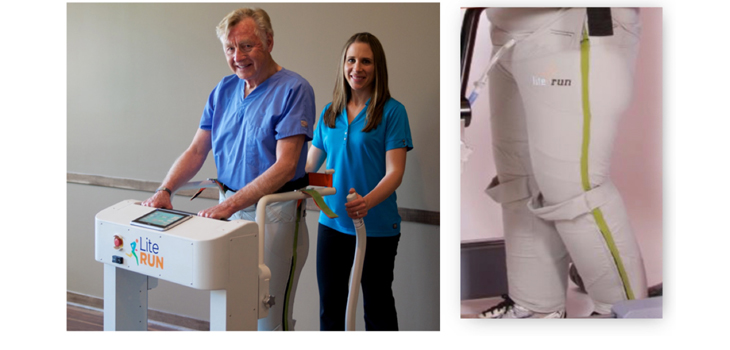
So, here is Billie’s description of that system and a few pictures to help explain this pretty cool new technology.
A Most Uplifting Experience for This Writer

Air Lifting Device Holds Hope for Stroke and Head Injury Victims
Among the more physically challenging jobs in a hospital are those performed by physical therapists who, with an assortment of belts, straps and harnesses, support and guide their patients onto their feet and through a series of healing exercises. When patents are obese more than one therapist is required to safely manage the patient.
A group of five young inventor engineers (Pete Bobgan, John Hauck, Mark Johnson, Doug Johnson and Bruce Wigness) contemplated this problem. They noted that the water in a swimming pool exerts upward pressure on a body in the pool, lifting it up to the surface. Could, they wondered, air pressure do the same thing?
The result of their investigations is the Lite Run, a device that offloads a person’s weight so he can easily stand or be lifted to his feet. A patient weighing 180 pounds will have an effective weight of 90. Instead of water the Lite Run uses air pressure. Just as the pressure of water in a swimming pool pushes a swimmer’s body up and out of the water, the air pressure inside the suit lifts a patient off of the ground.

This writer tried out the device. First I donned a pair of trousers that were sealed at the waist and sat in a wheelchair. The chair was wheeled up to the Lite Run device. The operator typed a few numbers on a touch screen and suddenly I felt myself gently rising to my feet as if I weighed half of my 120 pounds. As the air pressure increased in the trousers, I continued to rise until I was standing on my feet. The trousers were not bulky nor uncomfortable and the fabric stretched and moved with me when I walked.
And I walked a lot. I was told that the device would catch me if I should fall and it has a special “sit to stand’ feature which provides assistance to get up from a bed or a wheelchair. When I (who am able bodied) tested the device I began to walk immediately. I found the suit to be comfortable, close fitting and responsive to my bodies’ movements. I found that the off-loading of half of my body weight made walking and balance far easier.
Because the Lite Run provides a comfortable, fall-proof solution for gait and balance therapy it allows for the engagement of patients at the earliest possible time for their treatment.
A study of 18 patients using the Lite Run device was presented at the Design Medical Conference in 2017. All ten participating therapists rated the Lite Run exosuit and device a score of 5 out of 5 for ease of use. Lite Run also received a 5 out of 5 rating for reduced burden on the therapists when they were delivering therapy.
The Lite Run allows for effective early stage therapy for patents in need of gait therapy, in cases of incomplete spinal cord injury, strokes and traumatic brain injury. The Lite Run suit was designed to expedite early patient recovery and improve patient safety. If a patient should collapse while in the Lite Run he will be perfectly supported by the system.
According to its manufacturers, because the Lite Run was designed to improve both patient and therapists safety it decreases labor costs. A single therapist can monitor any size patient during therapy and transitions. Lite Run received FDA clearance in July 2017.
Author
Discussion
This is a fascinating development. In my practice we've seen similar outcomes with the revised protocol. The key differentiator seems to be patient selection criteria. Has anyone else noticed the correlation with BMI thresholds?
Great point. I'd push back slightly on the conclusion, the sample size in the cited study is too small to draw population-level inferences. That said, the directional signal is compelling and worth a larger RCT.
We implemented a similar approach last year. Early results are promising but we're still gathering 12-month follow-up data. Happy to share our protocol if anyone is interested.
Join the conversation
Orthopedic professionals are discussing this. Sign in and upgrade to read every comment and add your voice.