
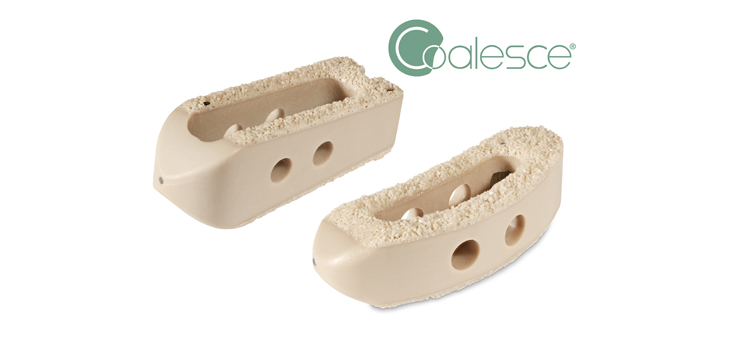
Vertera Spine has received FDA 510(k) clearance for its COALESCE Lumbar Interbody Fusion Device for use in anterior, transforaminal, posterior, and lateral lumbar interbody fusion procedures.
Vertera Spine Receives 510(k) Clearance for COALESCE
2 min read Premium comments
Secondary
As the company wrote in its July 25, 2017 news release, “COALESCE features Vertera Spine’s novel proprietary porous PEEK [Polyether ether ketone] biomaterial and is the second porous PEEK device to receive FDA clearance behind Vertera Spine’s COHERE Cervical Interbody Fusion Device. Vertera Spine will be launching COALESCE for TLIF and PLIF procedures in multiple footprint, height, and lordotic angle configurations later this year.”
“COALESCE combines the osseointegration capabilities of porous metal implants with the favorable imaging and mechanical properties of traditional PEEK implants. Unlike metal-coated PEEK implants that can delaminate, COALESCE’s porous PEEK architecture is grown directly out of the implant’s solid PEEK base and has an interfacial strength stronger than the shear strength of vertebral trabecular bone. Furthermore unlike 3D-printed metal implants, porous PEEK behaves mechanically similar to bone under compression, essentially eliminating any stress shielding effects, and does not produce any imaging artifacts enabling accurate visual assessment of fusion.”
“I initially became convinced of porous PEEK’s clinical benefits by the successful ACDF outcomes I obtained with the COHERE device,” said Gurvinder Deol, M.D., an early COHERE adopter from WakeMed Health and Hospitals in Raleigh, North Carolina. “However, I believe porous PEEK’s true value will be demonstrated with the COALESCE device in lumbar procedures where the biologic fusion environment can be more challenging, and the biomechanics more demanding on fusion devices.”
“Prior studies have demonstrated the importance of adding porosity to implants to create a strong bone-to-implant interface and more stable union. Supported by extensive research at Duke University and the Georgia Institute of Technology, COALESCE’s porous PEEK architecture, with 60% porosity and 300 mm average pore size, is specifically tailored to elicit the optimal osteogenic cell response and promote bone tissue ingrowth inside the pores…”
Vertera Spine CEO Chris Lee commented to OTW, “We had two interesting moments during the product development phase. The first was discovering how well the porous architecture withstood extreme insertion conditions that surgeons subjected the implants to during development labs. This was important to test early on to ensure the porous architecture maintained its structural integrity so that it could support bone ingrowth post-surgery. The second was seeing the promising ingrowth and fusion results from our large animal lumbar fusion study. With the study complete now, we plan on publishing and presenting the results later this year.”
“COALESCE is the first porous PEEK lumbar fusion device to receive FDA clearance. Vertera Spine has developed a process where the porous architecture is grown directly out of the solid PEEK implant and is not added on as a coating. This allows for the mechanical and imaging properties of regular PEEK implants to be retained, while creating an environment to promote bone tissue ingrowth. Good mechanical strength and toughness is particularly important in lumbar applications where fusion devices are exposed to complex and rigorous loading regimes.”
Author
React:
Discussion
This is a fascinating development. In my practice we've seen similar outcomes with the revised protocol. The key differentiator seems to be patient selection criteria. Has anyone else noticed the correlation with BMI thresholds?
Great point. I'd push back slightly on the conclusion, the sample size in the cited study is too small to draw population-level inferences. That said, the directional signal is compelling and worth a larger RCT.
We implemented a similar approach last year. Early results are promising but we're still gathering 12-month follow-up data. Happy to share our protocol if anyone is interested.
Join the conversation
Orthopedic professionals are discussing this. Sign in and upgrade to read every comment and add your voice.