
Since 1991—and again this year—the Shirley Ryan AbilityLab (formerly Rehabilitation Institute of Chicago) has been named as the number one in rehabilitation in the U.S. News & World Report!
Shirley Ryan AbilityLab: 27 Years at Top of USNWR List
2 min read Premium comments
Secondary
“Inspired by our patients, we have led the evolution of physical medicine and rehabilitation for more than a quarter century, pursuing innovation and breakthroughs with relentless determination,” said Joanne C. Smith, M.D., president and CEO of the Shirley Ryan AbilityLab, in the August 8, 2017 news release.
“Now, with the recent opening of our state-of-the-art facility, we are poised to set new global standards that will change the process for scientific discovery and the way healthcare is delivered with the goal of better recoveries—and even cures—for our patients. It’s a great honor to be recognized by physicians and U.S. News & World Report yet again.”
As the hospital wrote in its news release, “One patient benefiting from the Shirley Ryan AbilityLab’s integrated approach to care is Cole Thomas. Last September, Cole issued a plea via a video on Facebook. Following a car accident, he was told he would never walk again, a fate the young father couldn’t accept. The video went viral and was viewed 16 million times. It led Cole to the Shirley Ryan AbilityLab and recently, following months of intensive therapy, he walked out of the facility on his own.”
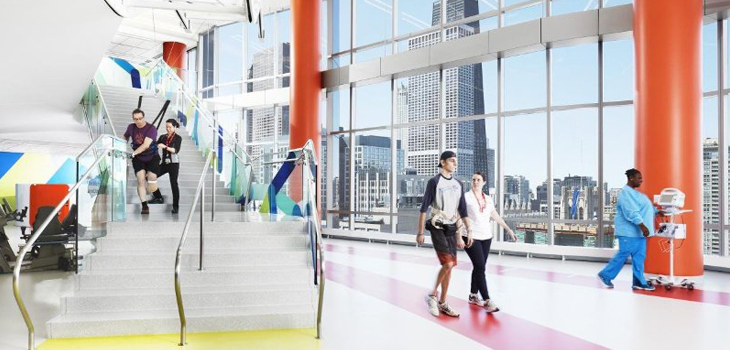
“The ranking comes on the heels of the March opening of the $550 million, 1.2-million-square-foot Shirley Ryan AbilityLab. The facility is the first-ever ‘translational’ research hospital in which clinicians, scientists, innovators and technologists work together in the same space, 24/7, surrounding patients, discovering new approaches and applying (or “translating”) research real time. Applied research focuses particularly in the areas of neuroscience, bionic medicine, musculoskeletal medicine and technology transfer.”
Dr. Smith told OTW, “Our new hospital has a ‘wet’ lab right inside, which equips us to study living human cells, to use biologics, pharmacologics, stem-cell and other technologies—all areas holding immediate and exciting promise. In this wet lab, scientists work on stem-cell biology and muscle physiology. We are now able to take live tissue samples from our willing patients and study them. This will increase the number and speed of discoveries because scientists are co-located with patients.”
Asked how challenging it is to keep up with new rehab technology, Dr. Smith said, “Our scientists are truly at the forefront of their fields. Now, in our new research hospital, they’re poised to leverage research and technology like never before. With direct, ongoing exposure to a clinical environment, scientists are conducting research with greater intention, based on the needs of patients that they observe directly. This model of translational research increases the likelihood that promising research ideas will be converted into viable medical treatments.”
Author
React:
Discussion
This is a fascinating development. In my practice we've seen similar outcomes with the revised protocol. The key differentiator seems to be patient selection criteria. Has anyone else noticed the correlation with BMI thresholds?
Great point. I'd push back slightly on the conclusion, the sample size in the cited study is too small to draw population-level inferences. That said, the directional signal is compelling and worth a larger RCT.
We implemented a similar approach last year. Early results are promising but we're still gathering 12-month follow-up data. Happy to share our protocol if anyone is interested.
Join the conversation
Orthopedic professionals are discussing this. Sign in and upgrade to read every comment and add your voice.