
LaPrade Wins Cabaud Award; Smoking, Drinking American Men Don’t Follow-Up; Gait Pattern More Important for Wear Than Component Positioning
7 min read Premium comments
#aossm#robertlaprade#gaitpattern#fluidlavageopenwound
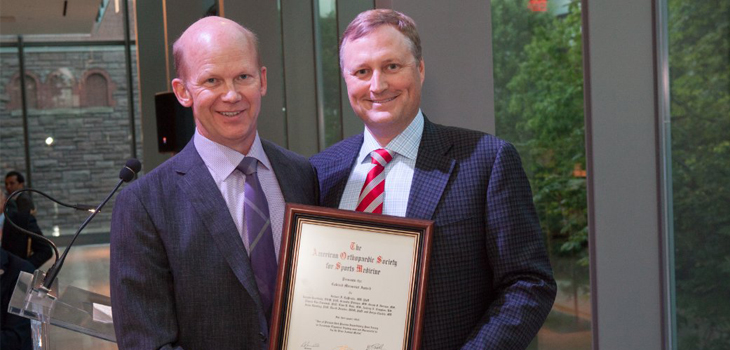
Robert LaPrade, M.D., Ph.D., chief medical officer at the Steadman Philippon Research Institute, has been honored with the Cabaud Memorial Award at the 2017 American Orthopaedic Society for Sports Medicine (AOSSM) Annual Meeting for his work, “Use of Platelet-Rich Plasma Immediately Post-injury to Accelerate Ligament Healing was not Successful in an In Vivo Animal Model.”
The AOSSM wrote in its accompanying press release, “This award, established in 1986 to honor the life and contributions of Henry Edward (“Ed”) Cabaud III, M.D., is given annually to the best manuscript submission pertaining to hard or soft tissue biology, in vitro research, laboratory or “bench-type” research, or in vivo animal research.”
“It is a distinct honor as the chairman of the AOSSM Research Committee to present this prestigious award to Dr. LaPrade and his colleagues,” said Dr. Matthew Provencher. “Dr. LaPrade’s continued leadership of breakthrough studies represents excellence in sports research and provides valuable information that ultimately benefits patients around the world.”
The AOSSM news release states, “The purpose of this biologic study was to determine whether a single dose of PRP [platelet-rick plasma] treatment at different platelet concentrations could accelerate healing of an injured medial collateral ligament (MCL) of New Zealand white rabbits. Eighty skeletally mature New Zealand white rabbits (160 knees) had their MCL surgically torn to simulate a grade III tear, were then administered PRP at three different platelet concentrations (0 [platelet poor], [2x PRP], and [4x PRP]) and then compared to a healthy contralateral knee saline injection control. The results of the study showed that one single dose of platelet poor plasma and two-times PRP at the time of injury did not accelerate ligament healing. In addition, a four-times dose of PRP negatively affected ligament strength and histological characteristics at six week’s post-injury.”
“It appears that the timing and dosing of PRP may be individual tissue (ligament, cartilage, bone, or muscle) specific,” said Dr. LaPrade. “The findings from our study raise concern that the current practice of treating knee ligament injuries, specifically MCL tears, with PRP immediately after injury or surgery may not improve healing at low doses of PRP, but could be harming ligament healing at higher PRP doses. We strongly recommend that further studies be performed to determine the dosing and timing of PRP administration after ligament injury before the widespread use of PRP to treat ligament injuries.”
Asked what some orthopedic surgeons may not understand about PRP, Dr. LaPrade, a complex knee surgeon at The Steadman Clinic, commented to OTW, “Many orthopaedic surgeons use PRP, but few recognize that there is a big difference in the composition of PRP depending upon the way it is processed.”
As for a “stand out” moment during his career, Dr. LaPrade noted, “It is hard to point to one outstanding clinical moment as a highlight. However, one that stands out was when I was in Norway and seeing 32 patients in follow-up with Lars Engebretsen and Steinar Johansen who were at an average four-year follow-up from the anatomic posterolateral knee reconstruction that we had developed. We could arrange for these patients to be seen over the course of two days. At that point in time, we had not seen many these patients back in follow-up. After we had seen all the patients and evaluated them, we sat down at dinner and Lars said to both of us, ‘these patients are doing amazingly well.’ It was a very proud moment for us because we recognized that all of our hard work had led to a solution to this complex pathology, which had often been called the dark side of the knee.”
Smoking, Drinking Men With Trauma Don’t Follow-Up
Keeping track of patients is no small feat…especially, says new research, if they are American males who smoke and drink lots of alcohol.
A new study, the Fluid Lavage of Open Wounds (FLOW) trial, measured patient characteristics which may or may not be associated with loss to follow-up within 12 months of an open fracture.
“Predicting and Preventing Loss to Follow-up of Adult Trauma Patients in Randomized Controlled Trials: An Example from the FLOW Trial,” (was published in the July 5, 2017 edition of The Journal of Bone & Joint Surgery.
Kim Madden, M.Sc., a member of the Department of Clinical Epidemiology and Biostatistics and Division of Orthopaedic Surgery at McMaster University, Hamilton, Ontario, Canada, told OTW, “This study came from our experiences in the FLOW trial where we discovered partway through the study that a number of participants were at risk of being lost to follow-up. A high rate of loss to follow-up could have led to reduced trial quality and possibly misleading conclusions.”
“We had put a lot of thought into designing our FLOW trial and it would be a shame to undo all of our hard work with a high rate of loss to follow-up. Therefore, we implemented several procedures and leveraged key design features to ensure that we would minimize our loss to follow-up to maintain the high quality of the trial. With our procedures to minimize loss to follow-up we could achieve a follow up rate of over 93% which is difficult in trauma populations, especially in such a large multinational trial conducted at 41 sites in 5 countries.”
“In our current study, we found that males, smokers, younger patients, patients who consume a large amount of alcohol, and patients in the United States healthcare system were significantly more likely to be lost to follow-up. Polytrauma patients and higher severity fracture patients were more likely to come back for follow-up visits. This gives investigators and trial coordinators an idea of who is most at risk of being lost to follow-up in trauma trials, so strategies aimed at reducing loss to follow-up can be targeted toward these high-risk trial participants.”
“The take-home message is that investigators in orthopaedic research should strive to minimize loss to follow-up, even in high-risk populations. The strategies that we found to be most successful for minimizing loss to follow-up were:
- Design the follow-up schedule to align with standard of care visits.
- Choose a primary outcome that does not require an in-person visit.
- Allow flexibility in the follow-up schedule (out of window visits are better than missed visits).
- Regular communication between the coordinating center and clinical sites about their loss to follow-up rates.
- Prioritize outcome measures to limit questionnaire burden.
- Persistence in attempting to contact high-risk patients (e.g. call alternate contacts, call at different times of the day, call on weekends, search local obituaries).”
Of course, if all else fails, implant a computer chip in all the smoking, drinking American males. (editor’s comment)
M-O-P: Gait Pattern More Important for Wear Than Component Positioning
Gait tests is an increasingly attractive source of vital information for orthopedic surgeons, says new research from Rush University Medical Center in Chicago.
The study, “Prediction of Polyethylene Wear Rates from Gait Biomechanics and Implant Positioning in Total Hip Replacement,” appears in the August 2017 edition of Clinical Orthopaedics and Related Research.
Markus A. Wimmer, Ph.D., director of the Human Motion Analysis and Tribology Labs at Rush, told OTW, “We started the work a decade ago but needed new mathematical tools (i.e. machine learning) to analyze the non-linear relationship between gait variables and wear at the hip liner.”
“We initially revisited the topic out of academic curiosity. Finding such strong relationships, however, came unexpected and we decided to spend more effort on the subject. I personally find it fascinating that the gait pattern of a patient carries so much information that can predict implant performance. Similar relationships might exist with other conditions where patient activity plays a role. Hence, gait may serve as a biomarker.”
“This was a retrospective analysis with all its flaws. It would be difficult to follow patients for 10, 15, or even more years prospectively. Since many surgeries were performed in the 80s, most of the records were not electronically kept. Many of the X-rays were no longer in the hospital and had to be retrieved from storage.”
The authors wrote, “Data on patients undergoing primary unilateral THR [total hip replacement] who performed a postoperative gait test were screened for inclusion. We included patients with a 28-mm metal head and a hip cup made of non-crosslinked polyethylene (GUR 415 and 1050) from a single manufacturer (Zimmer, Inc). To calculate wear rates from radiographs, inclusion called for patients with a series of standing radiographs taken more than 1 year after surgery…”
Dr. Wimmer told OTW, “I found it important that implant positioning and gait are not independent from each other.”
“This means, if our surgeons had this data set in the 80s they could have reduced the wear rate of some subjects in that they positioned the devices slightly differently. Nowadays, this is less important for wear because we have better materials. But similar relationships might exist for other issues (e.g. taper corrosion) which have not been investigated yet.”
“Another important result is that artificial neural networks are particularly well suited as analysis tools, when strong non-linear relationships have to be suspected.”
“The strength of the relationship and the possibility to predict the wear from a single gait test were surprising to me. We had no other information on the activity of the subjects. This means the gait pattern must carry information about the activity as well. (Just recently, we were able to preliminarily verify the latter on a small data set of subjects with activity and gait measurements internally.)”
“Implant positioning could be further optimized taking the dynamic environment of the individual patient into account. Also, a rehabilitation program that takes gait retraining into consideration could be considered.”
“The gait pattern seems to carry a lot of information and may serve as a useful biomarker. Recent technological advancements make gait analysis more easily accessible and might be included as a clinical assessment tool in the future.”
Author
React:
Discussion
This is a fascinating development. In my practice we've seen similar outcomes with the revised protocol. The key differentiator seems to be patient selection criteria. Has anyone else noticed the correlation with BMI thresholds?
Great point. I'd push back slightly on the conclusion, the sample size in the cited study is too small to draw population-level inferences. That said, the directional signal is compelling and worth a larger RCT.
We implemented a similar approach last year. Early results are promising but we're still gathering 12-month follow-up data. Happy to share our protocol if anyone is interested.
Join the conversation
Orthopedic professionals are discussing this. Sign in and upgrade to read every comment and add your voice.