
Medacta International, based in Castel San Pietro, Switzerland, has announced that the company’s USA Spine Division had a strong growth period in the first quarter of 2017, and that they have introduced key new products.
Medacta Spine: Strong First Quarter, New Products
2 min read Premium comments
Secondary
As the company wrote in its July 6, 2017 news release, “…the Medacta USA Spine Division nearly doubled its sales revenue from the comparable quarter last year. The division released three new products in 2016, including the MySpine Low Profile Guide, receiving numerous accolades for their clinical success and high praise from the surgeons who use them.”
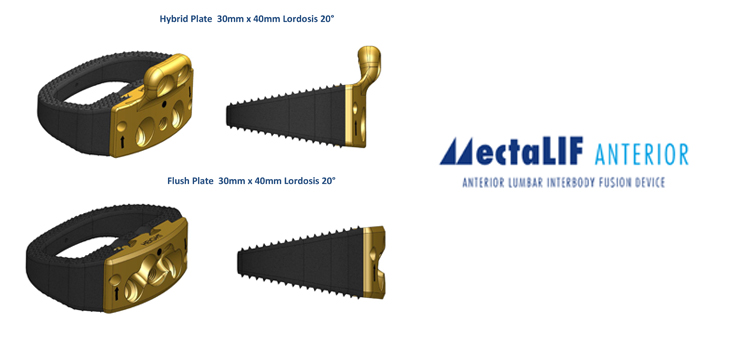
“Medacta’s latest innovation, the MectaLIF Anterior Hybrid Interbody Fusion Device, was cleared by the U.S. Food and Drug Administration (FDA) in February 2017 and will be an addition to the MectaLIF Cage product suite. The MectaLIF System aims to provide enhanced in situ stability, restoration of the native disc space height and lordosis, and long-term maintenance of the spinal balance. With the addition of the new hybrid configuration, the MectaLIF product line will now offer four different configurations (hybrid, anterior flush, anterior long, and anterior L5-S1), three footprints, two materials (PEEK or Titanium-coated PEEK (TiPEEK)), and hyperlordotic 20-degree cage options, allowing surgeons to target any patient-specific abnormalities they may encounter.”
“The addition of the MectaLIF hybrid configuration will enable personalized care for patients where additional stability is required and low profile construct is necessary to deal with difficult, tilted anatomies, by offering a flush caudal and long cranial profile in conjunction with low angle, diverging screws. In addition to the new configuration, the FDA cleared the hyper lordotic option and a 40x30mm footprint to further supplement the MectaLIF product suite and offer a wider array of options to patients.”
“The addition of the hybrid makes MectaLIF even more versatile,” said Dr. S. Raymond Golish, Medical Director of Medacta’s Spine Division. “We offer surgeons a wide variety of implants tailored to surgeon technique and patient anatomy to optimize outcomes.”
Asked what it took to reach the sales milestone, David Sponsel, U.S. Country General Manager for Medacta USA, told OTW, “A number of factors led to our standout quarter in Q1 2017. For one, we continued expanding our distribution sales force, adding hardworking individuals who are dedicated to spreading the word about our innovative spine surgery products. Surgeons are also continuing to adopt our MySpine patient-specific pedicle screw platform at a fast rate. Beyond that, we believe our procedural education offerings around ALIF and Complex Spine techniques have helped to convert more surgeons to partnering with Medacta by demonstrating our strong focus on surgeon education and training and patient well-being.”
“The most exciting aspect of these new spine products is the expansion of footprints and lordosis options, giving surgeons flexibility to make intraoperative decisions based on patient anatomy and desired surgical outcome.”
Author
React:
Discussion
This is a fascinating development. In my practice we've seen similar outcomes with the revised protocol. The key differentiator seems to be patient selection criteria. Has anyone else noticed the correlation with BMI thresholds?
Great point. I'd push back slightly on the conclusion, the sample size in the cited study is too small to draw population-level inferences. That said, the directional signal is compelling and worth a larger RCT.
We implemented a similar approach last year. Early results are promising but we're still gathering 12-month follow-up data. Happy to share our protocol if anyone is interested.
Join the conversation
Orthopedic professionals are discussing this. Sign in and upgrade to read every comment and add your voice.